


2018 School Spending Survey Report
Review of Queen of the Sea
In a graphic novel loosely inspired by sixteenth-century British history “during the reigns of King Henry VIII and his daughters, Queen Mary I and Queen Elizabeth I,” young Margaret has lived on the Island in a convent of nuns since she was a baby. At almost twelve (and nearly one hundred pages into the story), Margaret discovers an unhappy secret about her beloved Island and her own status there: she is in fact a prisoner. Soon after, the Island receives Lady Eleanor, the queen of Albion (modeled after Elizabeth I), who has been deposed by her older half-sister Catherine.
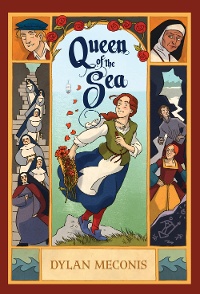 Queen of the Sea
by Dylan Meconis; illus. by the author
Middle School Walker U.S./Candlewick 396 pp.
5/19 978-1-5362-0498-8 $24.99
In a graphic novel loosely inspired by sixteenth-century British history “during the reigns of King Henry VIII and his daughters, Queen Mary I and Queen Elizabeth I,” young Margaret has lived on the Island in a convent of nuns since she was a baby. At almost twelve (and nearly one hundred pages into the story), Margaret discovers an unhappy secret about her beloved Island and her own status there: she is in fact a prisoner. Soon after, the Island receives Lady Eleanor, the queen of Albion (modeled after Elizabeth I), who has been deposed by her older half-sister Catherine. Distrustful of everyone else on the Island, Eleanor enlists Margaret as a companion, but this relationship eventually leads to another startling revelation, this time about Margaret’s parentage. When a mysterious ship washes ashore, its sole survivor alters the course of Margaret’s and Eleanor’s futures as they escape the Island together, in an open-ended conclusion. Sympathetic protagonist Margaret’s first-person narration occasionally pauses to enlighten modern young readers about religious practices, politics, and conventions of the period, such as convent holy hours, saints, and the rules of chess. These sections are often accompanied by spot art resembling images in illuminated manuscripts, whereas the rest of Meconis’s angular, detailed drawings depict characters realistically. Throughout, the mixed-media illustrations in an earthy palette are a dynamic mix of panel sizes and shapes that—along with the speech-bubble dialogue—reflect the emotions, intrigue, and actions of the complex characters, to great cinematic effect.
From the September/October 2019 issue of The Horn Book Magazine.


Added To Cart
RELATED


RECOMMENDED

Please register with us to continue reading.
ALREADY A SUBSCRIBER? LOG IN
We are currently offering this content for free. Sign up now to activate your personal profile, where you can save articles for future viewing.
ALREADY A SUBSCRIBER? LOG IN
Thank you for visiting.
We’ve noticed you are using a private browser. To continue, please log in or create an account.

Add Comment :-
Be the first reader to comment.
Comment Policy:
Comment should not be empty !!!