


2018 School Spending Survey Report
Reviews of the 2026 Newbery Medal Winners
Reviews of the 2026 Newbery Medal winner and honorees.
Winner
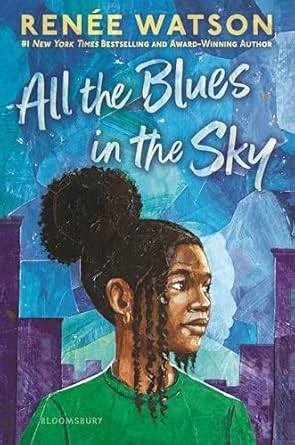
 All the Blues in the Sky
by Renée Watson
Middle School Bloomsbury 208 pp.
2/25 9781547605897 $17.99
e-book ed. 9781547605903 $12.59
“I didn’t know / best friends could die.” From the very first line, Watson takes a deep dive into the intricacies of grief and healing. On her thirteenth birthday, Sage is looking forward to spending the day with her best friend; instead, she receives news that her friend has been killed by a drunk driver. Her parents and aunt provide Sage with as much support as possible, even as she observes that adults don’t always know how to discuss death with one another, much less with children. She attends an afterschool grief group, where she connects with Ebony and DD, who understand “how death comes suddenly and without warning.” She also finds herself drawing back from loved ones as her emotions vacillate among sadness, anger, and guilt. Her attempts to streamline those emotions prove pointless, while interactions with friends, family, potential crushes, and even her beloved math class (“where everything makes sense”) show Sage there are no linear or concrete solutions in life, including in healing. Watson makes the wise choice to avoid neat resolutions to Sage’s process. An author’s note detailing her own recent experiences with grief adds impact to the idea that “the sadness & anger & laughter / don’t wait their turn.” A poignant story for all and a valuable resource for those experiencing grief and loss. EBONI NJOKU
From the March/April 2025 issue of The Horn Book Magazine.
Honors
 A Sea of Lemon Trees: The Corrido of Roberto Alvarez
by María Dolores Águila
Intermediate, Middle School Roaring Brook 304 pp.
9/25 9781250342614 $17.99
e-book ed. 9781250342607 $10.99
This historical novel in verse is based on the true story of Roberto Alvarez, a twelve-year-old Mexican American boy who was the lead plaintiff in a 1931 school segregation case in California. Mexican American students from Lemon Grove are slated to be sent to a segregated school in a retrofitted barn. The plan, made without public input, angers Roberto’s parents: “We cannot send our son to be educated en / una caballeriza!” The community decides to keep their children home rather than comply. Roberto is expelled for truancy, one family is deported, and others are threatened with job losses and forfeiture of government benefits. But the families persist, choosing bilingual and academically successful Roberto to represent them, and eventually win in court. Águila effectively conveys Roberto’s innocence. When he is first removed from his school, he wonders, “Why are they doing this? /I have the neatest handwriting in my class / and perfect attendance.” He’s also baffled and discouraged to learn that segregation is common in the United States. In shining a spotlight on this important case, Águila lays bare some of the harsh realities of discrimination, including some use of ethnic slurs (greaser, beaner), and readers may notice disturbingly timely parallels. Background information about the incident, an author’s note, and a bibliography are appended. MARVA ANNE HINTON
From the November/December 2025 issue of The Horn Book Magazine.
 The Nine Moons of Han Yu and Luli
by Karina Yan Glaser; illus. by the author
Intermediate, Middle School Allida/HarperCollins 432 pp.
9/25 9780063284432 $19.99
Make space on your shelf for this delectable, suspenseful adventure spanning more than a thousand years. Eleven-year-old Luli Lee lives in 1930s New York City, in the tightly knit Chinatown neighborhood. Her family hopes to own their building, a seemingly unachievable goal during the Depression. As their dim sum restaurant and other businesses suffer, Luli looks for ways to support her family. Han Yu, also eleven years old, lives in eighth-century China. Despite his unusual gift with animals, including an elusive, protective tiger, he has not found his purpose. He helps his father make and sell steamed buns at a local market; when his family members fall ill, he begins a dangerous trek along the Silk Roads to acquire medicine and funds to help out. Sharing a curious yet intrepid spirit, Luli and Han Yu seek to support their families through difficult times in their own ways. Their stories weave together clues about an unusual silk artifact that bears traces of a mysterious poem that could result in a change of fortune for both families. Glaser infuses each unforgettable story line with immersive sensory details, situating the reader on the dusty trails of Han Yu’s trek or surrounded by Manhattan pushcart vendors calling out their delicacies for sale; interspersed black-and-white vignettes further provide a sense of time and place. Perfect for readers looking for historical fiction with both mystery and self-discovery. An author’s note offers background about the Silk Roads; a bibliography is also appended. J. ELIZABETH MILLS
From the November/December 2025 issue of The Horn Book Magazine.
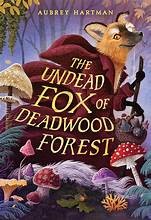 The Undead Fox of Deadwood Forest
by Aubrey Hartman
Intermediate Little, Brown 320 pp.
2/25 9780316575720 $17.99
e-book ed. 9780316575744 $9.99
Clare the fox lives, so to speak, in Deadwood Forest: “Like Clare, the forest was not quite dead but not quite alive.” He struggles with self-consciousness about his mangled ear and missing eye (the result of the accident that sent him to the forest), but for the most part follows a quiet routine as the Afterlife’s Usher of souls, tending his mushroom garden, reading books scavenged from Deadwood Dump, and making tea for himself and the wandering animal souls that knock on his cottage door. Mostly, the souls are easy to guide into one of the Afterlife’s four realms: Peace, Pleasure, Progress, or Pain. Then badger Gingersnipes, who doesn’t appear to belong to any realm, arrives just as Clare hears of an ominous premonition. Clare embarks on a quest to understand the meaning of the premonition and help Gingersnipes find her way. He engages in some surprising (to him) self-reflection and learns about love—for himself and others—as he travels through neighboring forests with his companion. Between chapters, detailed black-and-white drawings (by Marcin Minor) reminiscent of woodcuts highlight key characters and scenes to come. Though some of the book’s messages are a bit on the nose, ultimately the dry humor, an amusingly intrusive narrator, and a touch of nostalgia intertwine to create an endearingly strange snapshot of a cottage-core world caught between life, death, and the afterlife. MONICA DE LOS REYES
From the May/June 2025 issue of The Horn Book Magazine.
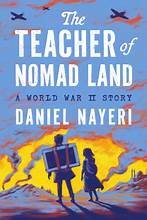 The Teacher of Nomad Land: A World War II Story
by Daniel Nayeri
Intermediate, Middle School Levine/Levine Querido 192 pp.
9/25 9781646145669 $18.99
Nayeri’s stirring historical novel—emotionally rich, suspenseful, and profound—sheds light on a lesser-known front of World War II: Iran, a neutral country occupied by both British and Soviet forces. Thirteen-year-old Babak and his younger sister, Sana, have been recently orphaned and are facing separation. Their bold decision to escape this fate propels them into a gripping tale of resilience and survival. The two first attempt to join a group of Bakhtiari nomads but are soon turned away. As they journey across the Zagros Mountains, the siblings encounter a threatening German spy and a prickly Jewish boy who is fleeing the Nazis, and their fates intertwine. Nayeri’s prose is lush and evocative, capturing the stark beauty of Iran’s mountainous landscapes as well as the traditions, languages, and beliefs that define its people. Along with vivid characterization, the novel balances action and introspection, weaving in issues of faith, identity, and empathy without slowing momentum. This poignant, often heart-wrenching narrative (despite occasional historical inaccuracies) offers readers a profound lesson in the power of communication, cross-cultural and cross-lingual understanding, and kindness. With a blackboard strapped to his back and a satchel full of books, Babak becomes a meaningful symbol of education as a bridge between people and cultures. Timely and unforgettable. ALICIA ROGERS
From the January/February 2026 issue of The Horn Book Magazine.
For more, click on the tag ALA 2026.


Added To Cart
RELATED


RECOMMENDED

Please register with us to continue reading.
ALREADY A SUBSCRIBER? LOG IN
We are currently offering this content for free. Sign up now to activate your personal profile, where you can save articles for future viewing.
ALREADY A SUBSCRIBER? LOG IN
Thank you for visiting.
We’ve noticed you are using a private browser. To continue, please log in or create an account.

Add Comment :-
Be the first reader to comment.
Comment Policy:
Comment should not be empty !!!