


2018 School Spending Survey Report
School stories
These six novels (some in verse), recommended for intermediate and/or middle school readers, tell all kinds of stories set in and around school.
These six novels (some in verse), recommended for intermediate and/or middle school readers, tell all kinds of stories set in and around school. See also the Schools--Elementary schools and Schools--Middle schools subject tags in the Guide/Reviews Database, and the July issue of Notes with its back-to-school focus.
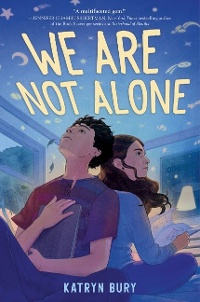 We Are Not Alone
by Katryn Bury
Middle School Harper/HarperCollins 320 pp.
10/24 9780063337411 $19.99
e-book ed. 9780063337435 $9.99
As Sam Kepler Greyson heads back to school for the first time after going through chemo, he’s still worried about his illness — now in remission — and processing the loss of his best friend, Oscar, who died from brain cancer. He doesn’t expect things to get better when he’s paired with Cat Pellegrini for their eighth-grade California history project, especially when Cat’s friends start speculating that he lied about being sick for attention. Sam becomes even more determined not to talk about his cancer — to anyone, including his moms — even when he starts having concerning symptoms. But Cat turns out to be the same kind of nerdy as Sam, and they connect over a favorite TV show and a passion for UFOs. With Cat’s help, Sam continues the work he’d begun studying extraterrestrials with Oscar, and together they follow clues to locate the author of a mysterious article on the subject. When a health crisis puts his friendship with Cat at risk, Sam has to deal with things he’d rather avoid. The book deals honestly with conflicting emotions of some cancer survivors (including Bury, as an author’s note explains) without becoming maudlin, with Sam’s wry sense of humor at the core. The cancer and UFO plot threads interweave elegantly, and the book offers possibilities but no easy answers. SARAH RETTGER
 Deer Run Home: A Novel in Verse
by Ann Clare LeZotte
Intermediate, Middle School Scholastic 224 pp.
10/24 9781339021904 $18.99
e-book ed. 9781546109808 $18.99
Having written several works of historical fiction with d/Deaf characters, LeZotte (Show Me a Sign, rev. 9/20, and sequels) now turns to a setting in which the issues that compromise the mental and physical well-being of d/Deaf children are contemporary and immediate. This first-person, present-tense verse novel accelerates suspensefully in a series of vignettes, events, and reflections. Effie lives with her older sister and alcoholic father, having been cast out of her mother and stepfather’s house. None of her family has learned American Sign Language, the only language fully accessible for her; it’s left to her school interpreter, Miss Kathy, to provide deep refreshment to Effie’s love- and communication-thirsty soul. In brief, spare entries, Effie conveys her fears and isolation, enjoys a new friendship with a classmate with cerebral palsy, and finally finds a way to tell Miss Kathy about her stepfather’s sexual predation. Miss Kathy applies for custody, which is granted after a tense three-day hearing; Effie’s father is found to be an unfit guardian because he refuses to learn ASL. (LeZotte reports in her author’s note that she based her plot on a similar, historic case in the d/Deaf community, and that three out of four hearing parents do not learn to sign with their deaf children.) LeZotte packs a great deal into this very quick work, and while the complexity of anguish, isolation, language trauma, and sexual abuse Effie suffers could merit fuller expression, the story can pique interest and raise awareness of what it is like to grow up d/Deaf in a non-signing family, using ASL interpreters, or confronting false assumptions about disability. DEIRDRE F. BAKER
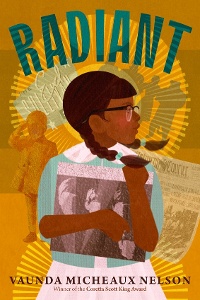 Radiant
by Vaunda Micheaux Nelson
Intermediate Dutton 320 pp.
1/25 9780593855782 $18.99
e-book ed. 9780593855799 $10.99
In this historical novel in verse, fifth grader Cooper Dale is growing up near Pittsburgh in 1963 and grappling with issues concerning her identity as a Black child attending a predominantly white school. While her family encourages her to embrace who she is, Cooper doesn’t always feel that way: “Sometimes / I don’t want to be black.” Mama tells her that she has to “study harder” and “shine brighter” in school due to racism. Wade Carter, a racist classroom bully, makes things even harder, calling Cooper “Mud Face” and “Tar Baby.” Things get worse when Cooper’s mom takes a job as the Carters’ maid. At first, this is just another thing for Wade to lord over her, but it ends up being the impetus for Cooper to see her tormentor in a new light and for him to change his behavior. Wade’s mom is seriously ill, and once she learns this, Cooper slowly begins to feel compassion for him and fully embraces Mama’s call to “be radiant” along with their church’s beliefs about mercy. Nelson has created a likable character in Cooper, and this quiet, introspective novel (with some moments of levity; e.g., Cooper’s embrace of Beatlemania) effectively examines what it means to forgive along with the importance of family. MARVA ANNE HINTON
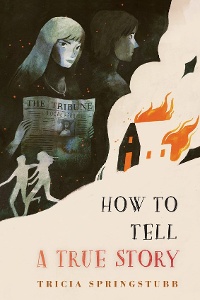 How to Tell a True Story
by Tricia Springstubb
Middle School Ferguson/Holiday 304 pp.
4/25 9780823458486 $17.99
e-book ed. 9780823462209 $10.99
From the opening chapter, Springstubb (Looking for True, rev. 11/22) creates a sense of unease by deftly foreshadowing an impending disaster. And so it happens: the Prices’ home burns to the ground. During the fire, seventh grader Amber is trapped in the attic; her older brother, Gage, heroically rescues her, and although the Prices lose their house and their possessions, they survive. Sort of. Amber, her mother, and younger sister move in with Amber’s maternal aunt while Gage and their father rent an apartment, making Amber realize that her parents’ fighting may well be leading to divorce. Amber, who considers herself as nondescript and amorphous as an amoeba, returns to school, suddenly the center of attention and the darling of the popular kids, putting her sometimes at odds with her previous besties but allowing her longtime crush to notice her. To complicate matters, her classmates instigate a fundraiser, the Price of Kindness, to help the family, a gesture her proud father wants to reject. And Gage becomes more and more withdrawn and noncommunicative. Short chapters allow readers to contemplate each action and reaction as information surfaces about the cause of the fire. Amber struggles with obligations to the family, relationships with friends and classmates, and her own sense of self. From middle-school angst to big moral questions, this fast-moving story covers much territory without crowding the narrative. BETTY CARTER
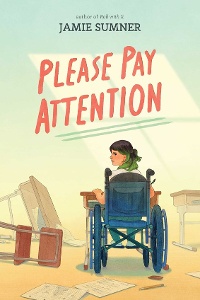 Please Pay Attention
by Jamie Sumner
Intermediate, Middle School Atheneum 240 pp.
4/25 9781665956079 $17.99
e-book ed. 9781665956093 $10.99
In a series of entries in verse, sixth grader Bea Coughlin narrates the story of something important she wants us to “please pay attention” to. Bea tells her story slowly, revealing characters and their relationships in a controlled way that keeps readers intrigued as they put the different pieces together. We eventually learn that she has cerebral palsy, was adopted by Max (her NICU nurse) as a baby, has a penchant for dyeing her hair funky colors and doing magic tricks, and uses a wheelchair. The novel is organized into four sections (“Seek,” “Hide,” “Heal,” and “Hope”) and unfolds starting with “ten days before.” It then counts down to the day a shooter enters Bea’s school. Afterward, she confronts her vulnerability as a wheelchair user, while the steadfast Max provides a much-needed counterbalance: “you are a child, / and that was a tragedy, / and we will get through this together.” She slowly processes the traumatic event through writing, therapeutic horseback riding, and, eventually, activism. In a letter, Bea implores her state’s governor, and indeed all of us, to “please pay attention / and then / act.” An emotionally gripping story about school violence, trauma, and recovery, whose focus on disability and mobility asks important questions about common assumptions and protocols of disaster preparedness and safety. JULIE HAKIM AZZAM
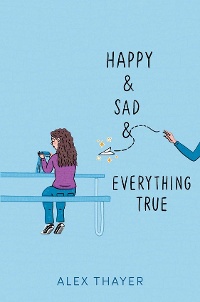 Happy & Sad & Everything True
by Alex Thayer
Middle School Aladdin/Simon 272 pp.
11/24 9781665955249 $17.99
e-book ed. 9781665955263 $10.99
Dee is struggling in sixth grade: she hears other girls gossiping about her appearance, sees her single mom flirting with her gym teacher, and feels like her best friend is ignoring her. Thayer dictates Dee’s stream-of-consciousness observations through occasional mental lists that read like free verse (“in the future /stop asking so many questions! / stop talking so much!”) and heightened sensory details (her school-bathroom refuge features cool-to-the-touch “wet-noodle” wall tiles and a leaky faucet’s refrain of da-wip, da-wip) that define her perceptive, sensitive mindset. Dee finds unexpected comfort in commiserating with classmate Harry through a grate connecting the girls’ and boys’ bathrooms, and the vent inadvertently turns into a confession booth where students ask for Dee’s help coping with their fears. These amateur advice sessions allow her to offer her classmates — whose problems are mostly mundane and easily fixed — some of the comfort and direction for which she also longs. Thayer champions the positive impact of Dee’s kindness while demonstrating how ignoring her own anxieties only makes helping others more difficult. Most touching is an investigation of the parental impact on a child’s views: after witnessing the negative behaviors that her peers inherited from their parents, Dee grows to appreciate her unconventional mother’s support and the empathy she’s been taught. EMMA SHACOCHIS
From the September 2025 issue of Notes from the Horn Book.


Added To Cart
RELATED


RECOMMENDED

Please register with us to continue reading.
ALREADY A SUBSCRIBER? LOG IN
We are currently offering this content for free. Sign up now to activate your personal profile, where you can save articles for future viewing.
ALREADY A SUBSCRIBER? LOG IN
Thank you for visiting.
We’ve noticed you are using a private browser. To continue, please log in or create an account.

Add Comment :-
Be the first reader to comment.
Comment Policy:
Comment should not be empty !!!