


2018 School Spending Survey Report

Find more great Horn Book content at these links:
Recommended books: reviews and themed booklists
App and e-book reviews
Movie reviews
Event news and recaps
Events calendar
Solve the Outbreak app review
Work your way up the Center for Disease Control's ranks from trainee to master "disease detective" by uncovering the causes of disease outbreaks in Solve the Outbreak (CDC, 2013).
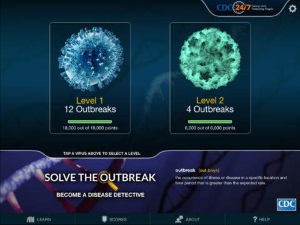 Work your way up the Center for Disease Control's ranks from trainee to master "disease detective" by uncovering the causes of disease outbreaks in Solve the Outbreak (CDC, 2013).
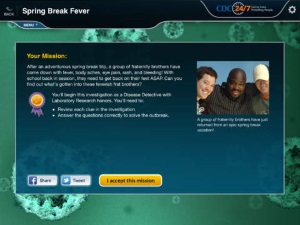
Every chapter presents background on a fictionalized outbreak and five clues, each followed by a multiple choice question to narrow down the outbreak's source. The clues are supplemented with patient profiles and charts of data, notes on the diseases' characteristics, tips for avoiding the featured disease, maps and stock photos, and clear definitions of unfamiliar terminology. After each chapter's fifth Q&A, receive the "results" with your points and achievement badges — and hopefully a promotion! There's also an opportunity to read about the real case(s) that inspired that chapter's outbreak mystery.
As you investigate the cases, you'll learn about specific diseases — culprits include E. coli, lead poisoning, West Nile Virus, Legionnaire's disease, and norovirus — and their transmission as well as methods for tracking and containing outbreaks. The tone is light and engaging (e.g., snappy CSI-worthy chapter titles such as "Up Sick Creek" and "Connect the Spots") without minimizing the dangers of disease epidemics or the importance of preventative measures.
Earn a perfect score solving the twelve outbreak cases in level 1 (don't worry; you can do-over as much as needed) to access the four cases in recently added level 2 and earn specialist honors.
A few of the Q&As are gimmes; here's an example from "Midterm Revenge," the case of college students with a stomach bug:
"What should you do now?
- Tell the sick students to stop partying so hard and go to class
- Keep the sick students in the same area until their symptoms are gone
- Find out if others are sick as well"
But overall, the information is solid, the mysteries are satisfying, and the format promotes both critical thinking and understanding of the scientific method. An "About the CDC" section and interspersed links to the CDC's website provide additional health tips and contextual information on the CDC's mission and programs.
If (like me) you liked American Museum of Natural History's The Power of Poison app, give this one a try. Solving the cases will have you feeling like legendary disease detective George Soper — or possibly just feeling a little more germophobic than before.
Available for iPad (requires iOS 6.0 or later), for Android devices, and on the web; free. Recommended for intermediate users and up.


Added To Cart
RELATED


RECOMMENDED

Please register with us to continue reading.
ALREADY A SUBSCRIBER? LOG IN
We are currently offering this content for free. Sign up now to activate your personal profile, where you can save articles for future viewing.
ALREADY A SUBSCRIBER? LOG IN
Thank you for visiting.
We’ve noticed you are using a private browser. To continue, please log in or create an account.

Add Comment :-
Be the first reader to comment.
Comment Policy:
Comment should not be empty !!!