


2018 School Spending Survey Report

Song of a Blackbird
Will the Committee consider Maria van Lieshout's Song of a Blackbird — a graphic novel?
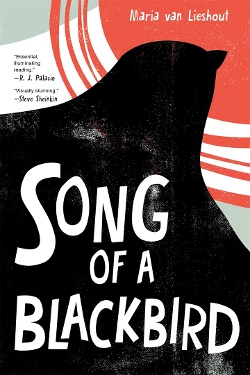 Maria van Lieshout's Song of a Blackbird is a harrowing and hopeful story, grounded in historical events, of the Dutch Resistance during World War II. Through expressive illustrations and inventive page layouts, this graphic novel weaves documented and imagined histories; past and contemporary timelines; and several characters' narrative arcs into a powerful and inspiring whole.
Though protagonists Annick (living in Amsterdam in 2011) and Emma (in 1943 Amsterdam) never meet, their stories are profoundly intertwined, initially through printed images of six buildings. Instructive fold-out front and back covers provide both wartime and present-day maps of these and other historic sites. Here, and throughout the book, Van Lieshout's architectural renderings and text lettering evoke the copperplate printing that plays a key role in the story, lending the illustrations a handmade, expressive humanity as well as historical ambience.
The opening pages also introduce the blackbird, a figure rendered in simple profile that perches, swoops, and soars through the story. From its high vantage, the blackbird provides narrative overview and historical context. More importantly, it serves as an eye-catching symbol of hope and courage, appearing whenever characters — and readers — need a reminder of beauty in the face of darkness.
Appropriate to its depictions of fear and suffering under Nazi occupation, the book's palette is mostly limited to black, white, and gray. However, cleverly deployed splashes of color distinguish characters, direct the eye, and emphasize narrative inflection points: red might highlight Emma's coat or the flames from firebombing, while orange calls out Annick's scarf or vibrant street art.
Van Lieshout brilliantly harnesses the graphic novel form to bridge time and space, history and memory. Photograph-like portraits of the characters "freeze" the story to emphasize narrative context, moments of moral clarity, and emotional touchpoints. An early spread opens on such an image, in which a worried Annick is embraced by her grandmother. Below, as the grandmother ponders her prints of the mysterious buildings, fanciful, decorative bird shapes in the wallpaper of her modern living room transform into actual birds, which she at first regards with joy — but the shadowy figure of her younger self sees that those birds are in fact German bombers. As suppressed memories rush in, the grandmother's speech bubbles appear in short, staccato bursts; at the bottom of the page, beneath images of falling bombs, it is Annick who now holds her grandmother in a comforting embrace.
One of van Lieshout's standout techniques is the layering of drawn characters over historical photographs of the settings in which the story takes place. In one scene featuring the imposing facade of the Dutch Theater, which was requisitioned by the Nazis as a Jewish deportation center, Emma — drawn as a small, cautious figure — slips through a door. The next spread brings us inside the war-damaged theater where Emma, with the guardian blackbird perched on her shoulder, surveys other drawn evidence of atrocity: threadbare mattresses, a child's abandoned lovey, a single shoe, and an empty violin case whose owner will never return. Like so many in the book, this image bears witness to devastation through quiet but profoundly effective means.
Young people are the truth-seekers and risk-takers of this story, and while the illustrations reflect the book's heavy subject matter, van Lieshout also imbues them with buoyancy. In an early scene, Emma and her friends, concerned about the fate of their detained Jewish neighbors, discuss whether or not to join the resistance. Van Lieshout draws them from above, lying on the grass in dreamy repose with their bookbags as pillows; elm seeds flutter to the ground and whimsical vines border the page. The youngsters look as if they could be cloud-gazing or making weekend plans, though the watchful blackbird perched in the lower corner signals that much more is at stake.
The book's 256 pages abound in examples of van Lieshout's endlessly inventive, nuanced, and empathic illustrative powers. Each, however, is in service of a story so gripping, heart-rending, and urgent that they may not call attention to themselves on a first, or even second, read. The exception that proves the rule is the book's sole full-color spread, which appears near the end of the story, and which many readers will view through tears. Song of a Blackbird is not an easy book, but it is a necessary and loving one that, on every page, embodies the power of art to save souls as well as lives.
[Read The Horn Book Magazine review of Song of a Blackbird]

Added To Cart
RELATED


RECOMMENDED

Please register with us to continue reading.
ALREADY A SUBSCRIBER? LOG IN
We are currently offering this content for free. Sign up now to activate your personal profile, where you can save articles for future viewing.
ALREADY A SUBSCRIBER? LOG IN
Thank you for visiting.
We’ve noticed you are using a private browser. To continue, please log in or create an account.

Add Comment :-
Be the first reader to comment.
Comment Policy:
Comment should not be empty !!!