



2018 School Spending Survey Report

Tell us about your mock Caldecott results
Every year we like to solicit responses from anyone who has held a mock Caldecott with their students, library patrons, or bookstore customers.
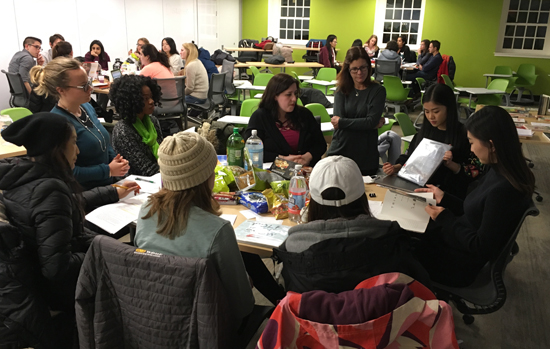 Three mock Caldecott groups meeting at Harvard Graduate School of Education in fall 2017.
Every year we like to solicit responses from anyone who has held a mock Caldecott with their students, library patrons, or bookstore customers. The first few years of Calling Caldecott, I was in awe of Robin Smith's annual mock Caldecott with second graders, but it seemed like so much work! Eventually, I took the plunge with my own (adult) children's literature students, and now I wonder what I was so afraid of? The benefits FAR outweigh the logistical issues.
So now it's your turn. What were the results of your own mock votes? If you've never held any, use the comments to ask for advice. To get that started, I offer some links below.
- Calling Caldecott 2012 post about mock Caldecotts (plus 9 helpful responses)
- Calling Caldecott 2015 post with results but also advice for holding mocks (87 comments!)
- Leda Schu tells how it's done in Vermont
Finally, Colby Sharp's 24-second video of his students waiting to hear the results of a 2015 mock Caldecott is the all-time best advertisement for why you should give this a try. He's got it pinned to the top of his twitter page here. (Be ready to turn your volume down — the screams are deafening!)


RECOMMENDED
Please register with us to continue reading.
ALREADY A SUBSCRIBER? LOG IN
We are currently offering this content for free. Sign up now to activate your personal profile, where you can save articles for future viewing.
ALREADY A SUBSCRIBER? LOG IN
Thank you for visiting.
We’ve noticed you are using a private browser. To continue, please log in or create an account.

Add Comment :-
Comment Policy:
Comment should not be empty !!!
Emmie Stuart
It has been so fun reading all of the Mock Caldecott results! We're voting today (last minute is this librarian's modus operandi) and I'll announce our school winner this afternoon right before dismissal. Here are a few things that we do in our library (a public elementary school in Nashville) that help the Mock Caldecott process run smoothly. Library testing, being crunched for time, and snow days can be definite obstacles...hopefully these ideas will be helpful! In late November and early December, I dedicate an entire class period (typically about 45 minutes) to the Caldecott Medal and the Caldecott process. During this lesson we discuss the history of the medal, the Caldecott Committee, past winners, and then we practice reading a picture book "like the Caldecott Committee". In our library it's called being a "Robin Reader", after Robin Smith. Being a Robin Reader means looking at the book's shape and size, feeling the cover, unfolding the book, noticing the endpapers, illustration techniques, fonts, etc. Calling Caldecott contributor Megan Dowd Lambert's book "Reading Picture Books With Children" is a great resource for this lesson. During the last 15 minutes, I give each student a past Caldecott Winner and we go through the process together. I've found that laying this strong foundation helps the rest of the Mock Caldecott process run efficiently. Another tip is letting teachers borrow the books to read aloud to their classes. Several of my teachers enjoy reading one book right before dismissal each day. I make sure the teachers know how to be a Robin Reader. ;) I also have a Caldecott Corner in the library. I keep all of our nominees on a silver tray on the table. Students know that they can come in and look at the titles whenever they have free time during the day. A few teacher use this as a reward for students who finish their class work. Last tip - and this may not work for all public schools - I have an interactive white board. I buy the Kindle versions of the books for class read alouds. I hold the actual book in my hand while I read, but the size of the illustrations on the interactive white board are great for class read alouds. Each year I tweak the process. It's not perfect by any stretch of the imagination. BUT it is one of "the most wonderful times of the year".Posted : Feb 09, 2018 04:07
Elizabeth Lockwood
The 5th graders at Alexandria Country Day School selected... Medal Winner: Claymates by Dev Petty and Lauren Eldridge Honor Books: Dazzle Ships by Chris Barton and Victo Ngai The Book of Mistakes by Corinna LuykenPosted : Feb 08, 2018 06:18
Alys
The Mock Caldecott at our elementary school is finished, with the clear winner THE LEGEND OF ROCK PAPER SCISSORS. Honors went to AFTER THE FALL, BIG CAT LITTLE CAT, and CLAYMATES.Posted : Feb 06, 2018 05:13
Beleaguered School Librarian
We are voting this week so I'll post the results sometime over the weekend. We are voting on 12 nominees that I selected. However, I'm wondering for those of you who work in schools, particularly public schools, about the administrative support you receive. I'm impressed - and frankly amazed - at the number of books you are able to read and discuss and the high level of your discussions. Here at my NYC public school, my library was closed for 4 mornings in January and will be closed again for 4 mornings this month for mock testing. (Children with special accommodations get tested in the library - there are not enough rooms in the school. As usual, space constraints and real estate prices dictate much of NYC life.) The library is closed for meetings all too often. And sometimes classes just don't come to library, often when the teacher is pressed to finish assessments by a certain date, or to do test prep. Is this just a NYC thing? (This happens at the other NYC public schools I've worked at, too.)Posted : Feb 06, 2018 01:51
C. Maynard
We just got our results on Friday. Since we do this in a public library our nomination system looks a little different. We look at all of the mock short lists and choose ten titles, trying to hit varying reading levels, of which people can vote for their top five. Then once voting is closed we weight those ballots and are left with one medalist and four honor titles. Our Caldecott picks this year are Medal: Little Fox in the Forest Honors: Big Cat Little Cat Wolf in the Snow Grand Canyon Over and Under the PondPosted : Feb 05, 2018 03:11