



2018 School Spending Survey Report

The Secret Project
Here's a book with lots of starred reviews — and lots of controversy.
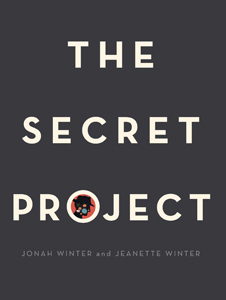 Here's a book with lots of starred reviews — and lots of controversy. What will the Caldecott committee make of that? Some will be reading every review and blog post they can find about each of their nominated books, while others will stay away from social media and review journals all year. While it might be interesting to look at how various committees handle social media, we won't be doing that now. Maybe later, or maybe it's better to leave that beast alone. This post will just look at this one book. Plenty!
The Secret Project, illustrated by Jeanette Winter, is about atomic bomb research and testing at Los Alamos, New Mexico, during WWII, and was written by Winter's son, Jonah Winter. It stands out because of its subject matter and because of the stark ending, which will undoubtedly lead to questions from children. Compared to other books on the bomb, this seems to be for a very young audience. As most of us know, children don't shy away from asking difficult questions. How will adults answer those questions? Will teachers and librarians even put themselves in a position where they might have to explain such discouraging information?
If you haven't seen this book yet, I may be getting ahead of myself. Let's go back a bit.
When I pick up a book illustrated by Jeanette Winter, I know what to expect. Her art is tranquil and neat, with simplified settings showing repeated shapes and flat colors. Somehow, the overall effect is not antiseptic; it's cozy. When I saw the subject of this book, I wondered how she could possibly illustrate a story so full of complexity, secrecy, and — let's be frank — the potential destruction of life on this planet. The first three quarters of the book are classic Winter, with cleanly imagined settings in tidy squares. And then, amazingly, she goes for it. As the scientists crouch down and wait for the first atomic bomb test detonation, the white space surrounding her images changes to a dark green. The text reads simply, "The countdown begins" and the page-turn reveals a dark green spread with no art. Just words in various sizes and shades — "Ten. Nine. Eight" — counting down to the smallest and lightest — "One…" Next, two wordless spreads show a sequence of four vertical rectangles with the infamous growing mushroom cloud. There is just one more spread, so what will that page turn reveal? Where is she going and what will she choose? The answer is: nothing. All we see is a flat black spread. Questions, anyone?
Because this is a modern-day information book, there is back matter to help answer some of those questions. The answers provided are stark, but they also contain a seed of hope, suggesting that it may someday be possible to reduce the number of nuclear weapons on this planet.
My adult self is so awed by the art and design of this book that it is difficult for me to imagine how I might have reacted as a child. When I first heard about nuclear weapons and their potential (at around age 6), my world view changed for good. Adult reassurance that the worst would "probably never happen" didn't help. Would I want to be the adult who changed a child's life in this way? Honestly, no. Do I think this book is gutsy, honest about its primary subject, and uses the picture book form to its fullest extent? Yes.
This might have been the end of my post. Except, remember that controversy? The Secret Project was published early in 2017. Soon after that, Debbie Reese (a Nambe Pueblo Indian woman and author of the "American Indians in Children's Literature" blog) pointed out some problems, and so did Edward T. Sullivan (author of The Ultimate Weapon: The Race to Develop the Atomic Bomb, 2007).
Reese has two primary objections. The text mentions Hopi Indians "in the faraway nearby," a repeated phrase Jonah Winter uses to get across the idea that there were very few people living near the test zone. A Hopi artist is shown "carving beautiful dolls out of wood,"
Sullivan believes that The Secret Project's attempt to write about the first atomic bomb in a picture book is "ambitious" and "laudable," but he describes the text as "misleading" due to various "factual errors and omissions" in descriptions of the project. Can the problems Sullivan points out be explained by the Winters' wish to translate a complicated situation into a narrative young children can understand? Will the committee, as part of their research, read Sullivan's book, as well as Steve Sheinkin's Bomb: The Race to Build — and Steal — the World's Most Dangerous Weapon? There's no question that being on the Caldecott committee involves reading more than than just picture books.
If I were on the Caldecott committee this year, The Secret Project would have started out on my personal Top Ten list. But I would also need to assess the problems that Reese and Sullivan point out. While it is clear that the Winters did substantial research, it is also clear that their research did not go far enough and did not include the best possible sources.
I am among the vast majority of people in this country who do not know enough about its indigenous populations. I wish my elementary-school geography and history lessons had devoted as much time to the actual history and roots of this land as they did to Columbus and the "discovery" of the New World. If they had, maybe everyone involved in creating and reviewing this book would have caught the errors Reese points out before the book was printed. I think the real tragedy of this situation is that our collective ignorance may have sunk what would otherwise have been an amazing and groundbreaking book.
So, can this book win the Caldecott? Can any book with a lot of controversy surrounding it win? My opinion is that the medal will never go to a book with a lot of social-media controversy. For a book to win, it needs a majority of first place votes. That's eight of the fifteen people discussing the books.
That's my hunch.
Read the starred Horn Book Magazine review of The Secret Project.


RECOMMENDED

Please register with us to continue reading.
ALREADY A SUBSCRIBER? LOG IN
We are currently offering this content for free. Sign up now to activate your personal profile, where you can save articles for future viewing.
ALREADY A SUBSCRIBER? LOG IN
Thank you for visiting.
We’ve noticed you are using a private browser. To continue, please log in or create an account.

Add Comment :-
Comment Policy:
Comment should not be empty !!!
Anon2017 (for purposes of identification only)
What an odd, ahistorical turn this conversation has taken. The Manhattan Project began in 1942, not mostly because of an idea that the weapon would need to be used in Japan, but because of a fear -- completely borne out by the facts, in fact -- that Nazi Germany was working on its own atomic weapon. Guess where the Allies would have used this weapon had the Battle of the Bulge gone differently? Yup, on white people in Europe. Guess where the white Nazis would have used the bomb first had they gotten to it first? Yup, on white people in Europe, Russia (well, Slavic, not white by their standards, I guess), or the USA. As for the racism implicit in the steps taken here in America to build the bomb, this is also ahistorical. The first reactor in the United States, the so-called Chicago pile was built and tested under the football stadium at the University of Chicago, a pretty white place at the time, though there had been talk of locating it in a forest not far from Chicago. Oak Ridge and Hanford were majority white, too, as were the areas noted in posts above, as were the actual Manhattan Project scientists self-exposing to the dangers (and who continued to participate in atomic research into the 1950s and 1960s after the Stalinist Russians, and totalitarian Russians, became a nuclear power). In light of this history, suggest we stick to talk of dirt roads leading into Santa Fe from the outskirts, an unnamed person some think is Georgia O'Keeffe, a reference "the faraway nearby" actually borrowed from the title of a haunting O'Keeffe painting of bones/skull/desert landscape, unhappiness that a particular Native nation was not mentioned while another was mentioned because of the faraway-nearby reference, and kachinas. Lolly is right.though. I'm not sure that more discussion on this will be fruitful.Posted : Nov 05, 2017 04:25
Patrick J.
Ann Clare: I don't know the Winters. I own most of their books and have second-hand knowledge of them through my friends in publishing. I have no stake in their careers and I am certainly not speaking for them. I have no idea what they feel and, unless you're privy to inside information, neither do you. I do know that other writers of children's books have had book contracts cancelled because of the manufactured scandals over other people's books. It is harder and harder for the vast majority of writers to make a living in this country. That might not be the case for you, but I know plenty who are struggling. It's much easier for tenured professors, teachers, and librarians to get by. If I had directed this sort of dismissive comment (about knowing the people I'm defending) at anyone else, it would be criticized for the patronizing and presumptuous remark that it is. I could have easily said that the only reason the critics of this book are criticizing it is because they all know each other and like to engage in ritual displays of mutual support, but I have chosen to address claims and to counter them with my own. You don't seem to be interested in addressing specific claims so instead you attribute my disagreements to some sort of personal grievance. The fact is that things are reaching a tipping point where a number of readers and writers and illustrators and editors are getting fed up with unjust attacks on people who are trying to do good work and whose futures are getting less and less secure. It's telling that one would think that in order to defend these people one would have to be on their bowling team or share a bodily organ with them. Having said all that, would you like to address any of my specific points? Thanks. Sarah H.: I read that. At the risk of some chivalrous commenter stepping in to say that I keep asking the same question, I'll ask it one last time: If the scientists knowingly harmed Native populations, then why did they expose themselves to the very same danger? This question is the big moldy lump in the pudding that you keep eating around.Posted : Nov 03, 2017 05:43
Sam Juliano
"The Winters have a strong, successful career. That’s not going to change." Ann, I fully concur. Jonah Winter just won a prestigious Ten Best Picture Book of 2017 designation from The New York Times for his wonderful prose for "Ruth Bader Ginsburg: The Case of R.B.G. vs Inequality" (with ace illustrator Stany Innerst), which offers further evidence of what Patrick stated earlier: "I am more interested in defending two artists who’ve committed their lives to social justice through art."Posted : Nov 03, 2017 05:33
Ann Clare
Thank you, Sarah, for the additional information. And to Debbie, for making your intentions clear. I often think people jump to the defense without taking the time to process your thoughtful reviews. Talking to a friend last night, I said the book was a misfire. I have admired other books by the Winters. Patrick, you obviously know the Winters. You feel for them, and think that this sort of criticism is a personal attack. There is also the false idea that there's a Twitter mob attacking authors/illustrators in a way that's never been done before. I can tell you that's not true. I published a book, T4: A NOVEL IN VERSE, in 2008. It has been harshly criticized and has a low rating on Goodreads. For my sanity, I don't read all the reviews. But I agree with the basic points. It is too short. It is a shame that a more thorough account of the subject matter doesn't exist in youth literature. I have not been criticized (as far as I know) for the Roma content, but I'm sure I used what someone in that community would see stereotypes and inaccuracies. ASL is my first language, and I've struggled with English literacy. That was the best I could do at the time. I'm always growing and learning. We can definitely be dedicated to social justice through art and get it wrong sometimes. The problem is not that you are defending your friends (I tell my family and friends to stay away from my reviews), but that you are dismissive and insulting to people from different cultures who see something differently from you. Any criticism is "absurd" to you. By keeping up this line of defense, the argument keeps spiraling. The Winters have a strong, successful career. That's not going to change. I hope when they get over the hurt they feel, they will be able to address concerns expressed by Debbie and others.Posted : Nov 03, 2017 04:25
Peter
I think that both sides can readily agree that the powers that be including the infamous Oppenheimer (so often referenced) were racists, and Sarah H's historical report is sound. It can be traced throughout history of course. I also understand that the people on this form who are arguing in behalf of "The Secret Project" and the Winters are progressive minded politically and artistically, as are those who have forged objections. All of us can roundly condemn this mindset then, now and for all-time. But there is still a vital fact in this picture that hasn't been considered after taking in the post's writer-moderator's statement in a comment: "It seems crystal clear to me that this area was chosen because the populations living there were seen as “lesser” by the people who had to choose where to create and test those bombs. In my opinion, this is a crucial part of the story and something children of any age can understand. I see no reason for omitting it." The problem with this statement is that the demographics in the immediate area where the test was conducted were roughly 50 to 60% Caucasian. Further research has revealed that those number have now increased as of 2015 to 85% Caucasian. If the scientists chose this spot exclusively because "lesser" people lived there, why then do the figures supporting that decision not line up? A few of the points that Sarah H. makes in her generally well researched and presented historical report are rather obvious - facts all would know (i. e. that the government was secretive about the entire process and that they would be concerned about concentrations of fallout on more populous areas. The bottom line is that these people had no idea what they were about to unleash and what the lasting ramifications would be. That they ended up conducting this test in a predominantly white area is ironic to say the least.Posted : Nov 03, 2017 03:41