


2018 School Spending Survey Report
The Writer's Page: The Impossibility of Writing Board Books
I started writing books for very young children in anger. A strange admission, I know. I was receiving a wobbly stack of board books to review for Kirkus each month, and I often vented about how developmentally inappropriate many were. I got holiday titles that read like extra-thick greeting cards and STEM board books attempting to explain coding or germ theory to babies. Although they may have looked like books for little ones, they were really speaking to adult beliefs about what babies and toddlers needed.
I started writing books for very young children in anger. A strange admission, I know. I was receiving a wobbly stack of board books to review for Kirkus each month, and I often vented about how developmentally inappropriate many were. I got holiday titles that read like extra-thick greeting cards and STEM board books attempting to explain coding or germ theory to babies. Although they may have looked like books for little ones, they were really speaking to adult beliefs about what babies and toddlers needed.
Was I angry enough to start writing board books? And could I get past my doubts? Reading, sharing, and recommending so many wonderful books as a children’s librarian and award committee member gave my inner critic all the fuel it needed to bloom into full imposter syndrome. But ultimately, my rage at the board book landscape was loud enough to shut up my inner critic. I wrote two board book manuscripts and a pitch for a board book series.
Cecily Kaiser, vice president and publisher of Rise x Penguin Workshop, read my pitch and bought one manuscript about a duo of roughhousing siblings, the imaginative worlds they co-create, and their navigation of hurt feelings and consent. But much to my surprise, she didn’t buy it as a board book at all: “We see this as a young jacketed hardcover picture book for ages 2–5.” Cecily’s thought was that the theme of the book (what to do when roughhousing play becomes “too much”) could and should skew to an older audience, and I had to admit she was correct and let go of my idea of a board book with lift-the-flap reveals. I stretched out the narrative and added a third sibling to increase the dramatic tension, all to make a slight board book manuscript into a thirty-two-page picture book.
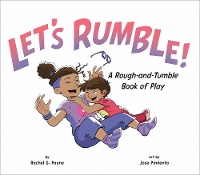 Let’s Rumble!: A Rough-and-Tumble Book of Play was born on July 8. Even though it was no longer the board book I’d imagined, I am delighted with the final picture book. Jose Pimienta’s illustrations are boisterous-fun incarnate, and the entire team at Rise — including Rae Peckman, book designer extraordinaire — made the hardcover package look wonderful. It was amazing for me, as a lifelong picture book reader, to experience firsthand each thoughtful choice that goes into the picture-book creation process.
But the irony is not lost on me that a board book critic couldn’t publish a board book. Why is it so challenging? Folks might think that board books are easy to write, but short and simple is hard and difficult. Author Susan Straub admitted she has also struggled in attempts to write them: “Board books’ texts must be sublimely poetic and exquisitely BRIEF. Writing a full length thirty-two-page children’s book is hard enough to get right; a board book is nigh impossible.”
The format, too, can be a hard sell. “I’m not sure if writing a board book is necessarily a challenge for children’s book authors, but writing one that publishers want to buy is,” author Alisha Sevigny shared with me. “Publishers may be reluctant to take on board books, citing high production costs, plus you are competing against a very established canon.”
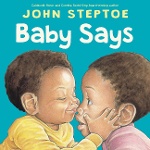
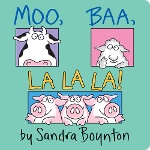 As a non-illustrator, I may be at a disadvantage because I can’t create my own visuals, which are essential for board books (and books for babies in general, including classics that started out as picture books). I wonder if editors might have dismissed the slight silliness of the brilliant Moo, Baa, La La La! without the perfect marriage of Sandra Boynton’s text and her dancing animals. Would the child-centered dialogue of Baby Says by John Steptoe have made any sense without the iconic images of the mischievous baby and the long-suffering brother?
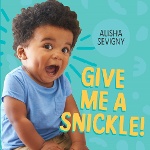
What so many of the great board book texts have in common is that play is at their heart. “I have more fun writing board books than I do writing any other type of book,” said author Anne Wynter. “When I’m so limited by word count, it feels freeing. For each of my board books, there was a good amount of revision, but it always felt like play.” And Sevigny shared about her book Give Me a Snickle!: “I didn’t set out to write a board book at all — I was playing with my son and we were snuggling and tickling and thus the idea of snickling was created out of our interaction.”
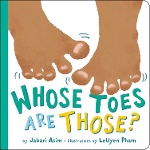
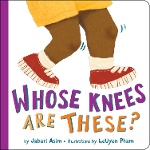 Board books also are not purchased or borrowed by the intended audience. And this may be part of my frustration with the board book landscape. What sells are love stories between a parent and a child, but it’s the rare title that finds the balance between what babies need and what parents want — like Jabari Asim’s Whose Toes Are Those? and Whose Knees Are These?, both illustrated by LeUyen Pham, celebrations of toddler antics embedded in loving verse.
While anger may be a good motivator to start writing, does this emotion stifle the playful approach that is needed for board book texts to thrive? Anger stops play in its tracks. And since there is no right or wrong way to play, it can be one of the best ways to shut up a very loud inner critic. Maybe the solution to my board book writing woes was staring me in the face all along.
Time will tell if I can actually figure out how to write an original board book text, but I’m going to keep playing. And even if I am not the one to write them, I’ll continue to champion books that playfully center the very, very young.
From the September/October 2025 issue of The Horn Book Magazine.
Single copies of this issue are available for $15.00 including postage and may be ordered from:
Horn Book Magazine Customer Service
magazinesupport@mediasourceinc.com
Full subscription information is here.

Added To Cart
RELATED


RECOMMENDED
Please register with us to continue reading.
ALREADY A SUBSCRIBER? LOG IN
We are currently offering this content for free. Sign up now to activate your personal profile, where you can save articles for future viewing.
ALREADY A SUBSCRIBER? LOG IN
Thank you for visiting.
We’ve noticed you are using a private browser. To continue, please log in or create an account.

Add Comment :-
Be the first reader to comment.
Comment Policy:
Comment should not be empty !!!