


2018 School Spending Survey Report

Tricky Vic
Robert Miller was known to everyone except his own family as Count Victor Lustig (or by any of forty-five other aliases).
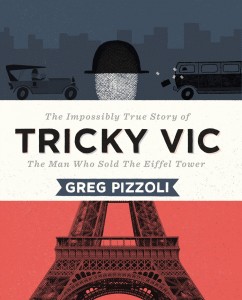 Robert Miller was known to everyone except his own family as Count Victor Lustig (or by any of forty-five other aliases). He was a con man, with a career full of ways to separate people from their money, including, believe it or not, selling the Eiffel Tower. He was "one of the most crooked con men ever to have lived." Not your usual subject for a children’s picture book, but Geisel Award winner Greg Pizzoli pulls it off. Like any good picture book, Tricky Vic: The Impossibly True Story of the Man Who Sold the Eiffel Tower is written with a light touch, and the mixed media illustrations are gorgeously simple-seeming with plenty of visual play that will appeal to children and adults alike, and which complement and extend the text. Vic’s face, for example, is not a face at all, but a fingerprint, and one of his "marks" (victims) was Frenchman Andre Poisson (French for fish), his head replaced with that of a fish, with a speech bubble saying, "He took the bait."
The beautiful design, the informative sidebars, and these amusing visual elements ought to play well with the Caldecott committee. These little touches are subtle but add up to a winning package. The muted color choices are a bit of a nod to the Elliot Ness era and allow the reader to feel as if he or she is in the middle of an old movie. A gray-green sensibility runs through the book, while the fingerprints and fish heads serve to keep the tone light. However, the committee may also consider one historical issue: Pizzoli says in his author’s note that he altered the actual timeline of Robert Miller’s story, placing Vic’s conning of Al Capone before the sale of the Eiffel Tower, when most accounts suggest he did that afterwards. Pizzoli felt he was giving precedence to character development over exact historical accuracy. Can he do that and have the book still be nonfiction? Will that matter to the Caldecott committee? As a former member of the Sibert committee, I can just picture the discussion through that Sibert lens. I think the Caldecott committee will see this as nonfiction: everything in the text is true — even if the sequence of events has been skewed — and it helps that Pizzoli points out what he did and why. It’s a bit of literary license in the service of good storytelling, which is what any book committee is looking to honor.


Added To Cart
RELATED


RECOMMENDED

Please register with us to continue reading.
ALREADY A SUBSCRIBER? LOG IN
We are currently offering this content for free. Sign up now to activate your personal profile, where you can save articles for future viewing.
ALREADY A SUBSCRIBER? LOG IN
Thank you for visiting.
We’ve noticed you are using a private browser. To continue, please log in or create an account.

Add Comment :-
Comment Policy:
Comment should not be empty !!!
Big Mama
I thought the book had a great deal of information, and the medium they used blended very well with the story. #BigMama's HousePosted : Dec 11, 2015 03:18
Susan Dailey
I've been thinking about the statement of adaptations of adult books. If the title is a picture book, does the addition of illustrations make it eligible? I'm think of "The Boy who Harnessed the Wind." An adult book was published in 2009. Then a picture book version came out in 2012.Posted : Oct 12, 2015 03:13
Elisa Gall
I wish I had that zine too, because if it is half as interesting and beautiful as the picture book, that's one amazing zine. I appreciate how this book leans to the older PB age range as well. It's not THIS ONE SUMMER old, but older than the average - or at least more mature (with the unapologetic booze and crime). :)Posted : Oct 11, 2015 06:58
Robin Smith
Wow. I am always amazed at how much work the committee has to do BEFORE they even meet. I wish I had that zine...Posted : Oct 10, 2015 10:57
Sam Juliano
Definitely among my favorite American picture books this year - Pizzoli's masterpiece.Posted : Oct 10, 2015 07:00