




2018 School Spending Survey Report

Water Is Water: A Book about the Water Cycle
In this exploration of the water cycle, Jason Chin uses watercolor and gouache to paint lovely scenes of a family's pond-side, rural homestead.
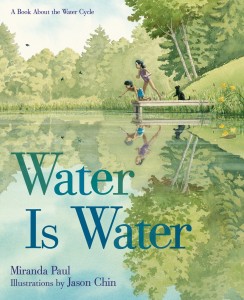 In this exploration of the water cycle, Jason Chin uses watercolor and gouache to paint lovely scenes of a family's pond-side, rural homestead. Each season is shown in vibrant colors and thoughtful details, and water is shown in a different form on each page. I particularly liked the choice to present the house and its surrounding field and pond from varying angles.
Miranda Paul's text pulls the reader on to the next page with an unless..., and then reveals the newest transformations. Rhyming words like swirl / curl, misty / twisty, and pack / smack lend a poetic air to the story. Picture books about scientific concepts can sometimes veer into the didactic, but Water Is Water feels like an engaging story about children who love being out in nature.
The two main children in the story are busy in their pursuit of turtles, snakes, and frogs, while their black cat watches their antics from the sidelines. The movement and the motion of the children on each page is a good analogy for the changing water cycle. I also liked the depiction of the children in various forms of play. At home and at school, they are running, chasing, skating, throwing snowballs, and pressing cider.
Of interest to the Sibert committee, if not the Caldecott committee, will be the back matter that includes a deeper exploration of the water cycle, suggestions for further reading, and a select bibliography. It seems as if nonfiction sometimes gets short shrift with award committees. It is difficult to compare the literary qualities of fiction with nonfiction. Is Water Is Water strong enough to overcome a possible bias toward fiction?


RECOMMENDED

Please register with us to continue reading.
ALREADY A SUBSCRIBER? LOG IN
We are currently offering this content for free. Sign up now to activate your personal profile, where you can save articles for future viewing.
ALREADY A SUBSCRIBER? LOG IN
Thank you for visiting.
We’ve noticed you are using a private browser. To continue, please log in or create an account.

Add Comment :-
Comment Policy:
Comment should not be empty !!!
Damon Dean, SevenAcreSky
If there is a "bias toward fiction" to overcome, Water Is Water has all that is required to overcome it. The requirement that good nonfiction must be factual tends to make us suspicious that any lyrical approach, any soft brushstroke, or any creative effort to serve up the facts waters down their reliability. In reality, literary and artistic presentations of facts deepen their meaning and relevance. Who cares about the facts unless they mean something? What's a fact without beauty, relevance, or worth? There should be no short-shifting here. Water Is Water has everything it needs to make a child learn, love, and appreciate the nature--and nurture--of water in their world.Posted : Nov 16, 2015 08:10
Jani ali
Reminding me my amazing childhood, when we ask questions about rainfall to our grandmother she told us same cycle in different words about water conversion from one form to other. this book repeats the the grand mom's story with more efficient presentationPosted : Nov 11, 2015 12:43
Eric Carpenter
Finally got a hold of this one yesterday and fell in love instantly. I read it with my mock caldecott group of first graders today and they were really digging into it. They had me pull out FLOAT and IF YOU PLANT A SEED to compare rain illustration techniques and seemed to all agree that Chin's water colors are most the most effective of the three. They had a lot of trouble coming up with anything that they didn't appreciate in this one. One student did mention that he wished the spread about mud had been a bit squishier. I think this is my new favorite. My only wonder (and maybe a parent could answer this for me) does it seem likely that both the brother and sister would have grown so little in a year (or at least 9 months) time that their bathing suits still fit them. Do kids grow enough in a year that they would need new suits by the following summer?Posted : Nov 10, 2015 05:09
Kimbra Power
My students have been loving the book trailer that we saw on Mr. Schu's blog; we've been singing the song all week...http://mrschureads.blogspot.tw/2015/10/2016-mock-caldecott.html Thanks for sharing your thoughts on this lovely story everyone Barefoot LibrarianPosted : Nov 06, 2015 01:13
Elisa Gall
Martha – You bring up an interesting question. On this handy site (http://water.usgs.gov/edu/watercycle-kids-adv.html) the USGS states: “The water cycle describes how Earth's water is not only always changing forms, between liquid (rain), solid (ice), and gas (vapor), but also moving on, above, and in the Earth. This process is always happening everywhere.” I remember learning the stages simply as evaporation, condensation, precipitation, & collection. I think this book shows these four stages effectively, through the visible steam (evaporation), clouds and fog (condensation), falling rain (precipitation), & plants absorbing the water in the muddy garden (collection). The guides from USGS are definitely more detailed, but I don’t think that makes the simplified version inaccurate. Science people, am I wrong on this? What’s your take?!Posted : Nov 06, 2015 11:53