


2018 School Spending Survey Report
Where Mother Nature and human nature meet
In these six nonfiction books, primary and/or intermediate readers can experience how people interact with, benefit from, study, and protect themselves from natural phenomena.
In these six nonfiction books, primary and/or intermediate readers can experience how people interact with, benefit from, study, and protect themselves from natural phenomena. For lots more, see the Science tag in the Guide/Reviews Database.
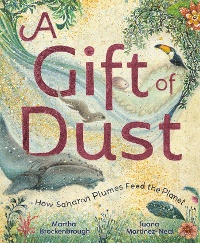
 A Gift of Dust: How Saharan Plumes Feed the Planet
by Martha Brockenbrough; illus. by Juana Martinez-Neal
Primary, Intermediate Knopf 40 pp.
5/25 9780593428429 $19.99
Library ed. 9780593428436 $22.99
e-book ed. 9780593428443 $11.99
“When a sunbeam slips through a window in a certain slant of light, you can see a scattered sparkle: dust!” Light, airy illustrations dotted with golden specks float across the pages, lending a near-magical atmosphere to a story that starts with a mother-to-be in a child’s nursery and then travels through space and time, providing clear and fascinating scientific explanations of Saharan dust along the way. Saharan dust appears in a region adjacent to the now-dried-up Lake Chad in northern Africa and comprises fossilized animals once living in the area. With straightforward depictions in both text and illustrations, the huge plume of dust is shown visible from space (as the text notes, it weighs about the same as “one hundred and twenty million female hippos”). Particles float westward, feeding the ocean with nutrients and plankton with nourishment that is passed on to the marine animals that feed on them. When traveling over the Amazon rainforest, the dust brings phosphorus, replenishing what’s been washed away with yearly rains. As Brockenbrough concludes, “This dust…of what lived once sustains what lives today.” An author’s note enlarges on the text and includes resources for further inquiry. BETTY CARTER
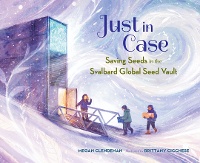 Just in Case: Saving Seeds in the Svalbard Global Seed Vault
by Megan Clendenan; illus. by Brittany Cicchese
Primary Charlesbridge 32 pp.
10/25 9781623544805 $17.99
Deep in the earth, protected by multiple sensors and systems, the Svalbard Global Seed Vault on an icy Arctic island ensures that the “priceless treasure” of more than 580 million seeds is kept safe from extinction. In this engaging picture book, Clendenan uses simple, clear language to explain why and how the world’s seeds are being preserved at such great effort and expense. The text consists of large type, with easily read words and sentences, and with frequent accompanying boxes of information in smaller type adding more detailed information, making the book good both for reading aloud and for those who are interested in learning more at a slightly higher level. In the digital art, Cicchese uses a palette of blues, whites, and purples to show the frozen land in its beauty, contrasting it with warm colors when portraying the various locations around the world where the seeds were originally, lovingly planted and saved. The book doesn’t shy away from why we need to take such good care to protect the seeds, including threats from natural disasters and acts of war, but the tone in words and pictures remains calm and reassuring. Back matter includes further information on the topic, an author’s note, and well-chosen resources for kids. SUSAN DOVE LEMPKE
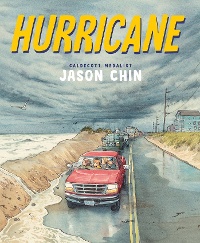 Hurricane
by Jason Chin; illus. by the author
Primary, Intermediate Porter/Holiday 48 pp.
5/25 9780823458493 $19.99
Hatteras Island off the coast of North Carolina is the scene for Chin’s latest: an examination of a hurricane (based on several real ones) brilliantly told in segments alternating between actions of island residents and those of scientists. After piquing readers’ interest with a dramatic cover depicting an angry sea and a line of evacuating cars, Chin defines a hurricane and describes early tracking measures by meteorologists who observe the storm. A dual countdown begins. On Monday, the storm forms off the coast of Africa and moves west across the Atlantic as residents warily continue with their daily activities. On Tuesday, scientists follow the storm’s path; residents begin discussing arrangements. And so on. The climax occurs when the storm makes landfall. Short narrative descriptions and spot art depict what is happening on shore: the rising surf, the destructive winds, the calm of the eye, and the hurricane’s return with its change in wind direction. And then it’s over. People return to their homes and help one another with the cleanup. Chin (The Universe in You, rev. 1/23) masterfully juxtaposes the experience of people affected by the hurricane with the larger scientific context; stunning illustrations in pen and ink, watercolor, and gouache bring life to massive weather phenomena and to smaller-scale scenes. Extensive back matter adds useful details about storm formation, meteorology, and forecasting; an author’s note addresses concerns about the importance of the meteorological community’s work and the effects of climate change. Suggested sources for further inquiry complete this outstanding book. BETTY CARTER
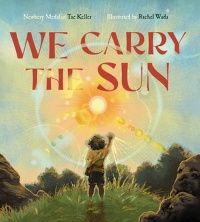 We Carry the Sun
by Tae Keller; illus. by Rachel Wada
Primary, Intermediate Norton 48 pp.
6/25 9781324031123 $18.99
Thousands of years ago, humans gathered under the sun’s rays for immediate heat. Then they began constructing homes that faced south to take advantage of that warmth. But could they carry that temperature inside and create permanent comfort? Such questions eventually led to the development of solar energy as early as the turn of the twentieth century, a noble if complicated effort that was often plagued by high costs and ineffectiveness but that is rapidly advancing and improving in modern times: “The sky is the limit.” Starting in Britain in the mid-eighteenth century, the introduction of cheap fossil fuels during the Industrial Revolution had produced energy, but, as Keller (most recently Jennifer Chan Is Not Alone, rev. 5/22) points out, individuals soon began questioning their use and the damaging cost to the environment. Scientists persisted by challenging the status quo and modifying solar models. Thumbnail sketches of individuals from around the globe and their contributions in producing cost-effective solar energy reflect a major theme: ideas grow “with people bouncing off one another like photons, teaching and inspiring, listening and learning.” Full-bleed illustrations, both informative (such as the depiction of the first solar home) and bold (as shown in the extraction of oil), enhance Keller’s compelling, poetic text in this, her first nonfiction picture book. Wada’s use of light (symbolically bursting across the pages as ideas are born) and dark (showing pollution and stagnation) further complements the narrative. Back matter consists of an author’s note; a solar energy timeline; and, in keeping with the theme that ideas start with “wondering, thinking, building,” sources for further study. BETTY CARTER
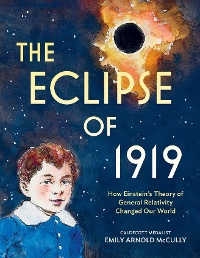 The Eclipse of 1919: How Einstein’s Theory of General Relativity Changed Our World
by Emily Arnold McCully; illus. by the author
Primary, Intermediate Ottaviano/Little, Brown 40 pp.
7/25 9780316475525 $18.99
This picture book serves as a good introduction to the concepts of scientific theory, methodology, and history involved in the role of a 1919 eclipse in proving Einstein’s theory of general relativity. Isaac Newton’s universal law of gravity stood unchallenged for two hundred years until Albert Einstein proposed his theory that speed affects mass, time, and space. It was a revolutionary proposition, but how could one test such a notion? McCully leads up to the answer to that question with a few pages of biographical information about Einstein and a basic explanation of his theory, establishing uncertainty: “But was it correct?” She explains that the effects of relativity “can’t be observed in the everyday world because everything is closer together than in space” and that the theory could be tested only during a total eclipse of the sun. World War I interrupted much scientific inquiry, and Einstein’s 1915 publication of his theory was virtually ignored. After the war, Arthur Eddington, director of the Cambridge Observatory, tested the theory during an eclipse in 1919, setting out with a colleague to a remote island on the west coast of Africa. McCully conveys the endeavor’s considerable drama — heavy rains obscured the sun that day, with the clouds parting just long enough to allow for the photographic evidence that would prove the theory; “overnight, Albert Einstein’s name became a permanent synonym for genius.” The text is illustrated with McCully’s recognizable watercolor, pen, and ink illustrations in a variety of shapes and sizes from spot illustrations to sweeping double-page spreads. An author’s note and source notes are appended. JONATHAN HUNT
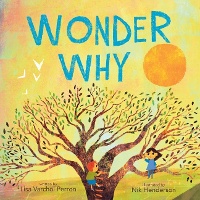 Wonder Why
by Lisa Varchol Perron; illus. by Nik Henderson
Primary Harper/HarperCollins 32 pp.
4/25 9780063310421 $19.99
Perron’s accessible STEM-friendly text about meteorological phenomena grounds itself in that quintessential question of childhood: “Why?” On alternating spreads, rhymed verses in a singsong cadence pose questions to the sky, wind, clouds, thunder, rain, and a rainbow. These queries all appear on pages that depict children, and each question includes the line, “How I wonder, wonder why,” implying a child’s voice. In response to the questions, each weather phenomenon replies with a scientific explanation (the wind: “Pressure! That’s what makes me blow. / Cool air moves from high to low”). These answers are reinforced with succinct statements in the back matter about each meteorological event. Henderson’s illustrations recall Jon Klassen’s style and make good use of perspective and scale to evoke the smallness of the child speakers in relation to the vast sky and the world we inhabit. Effective, too, are his use of color and shadow and his energetic line work to depict the dynamism and power of weather events. A great choice for readers wondering about weather. Appended with a selected bibliography. MEGAN DOWD LAMBERT
From the October 2025 issue of Notes from the Horn Book.


Added To Cart
RELATED


RECOMMENDED

Please register with us to continue reading.
ALREADY A SUBSCRIBER? LOG IN
We are currently offering this content for free. Sign up now to activate your personal profile, where you can save articles for future viewing.
ALREADY A SUBSCRIBER? LOG IN
Thank you for visiting.
We’ve noticed you are using a private browser. To continue, please log in or create an account.

Add Comment :-
Be the first reader to comment.
Comment Policy:
Comment should not be empty !!!