



2018 School Spending Survey Report

Windows
Would it be cheating if, for just a moment, I sent you to Martha’s review of Julia Denos’s Windows, illustrated by debut artist E.
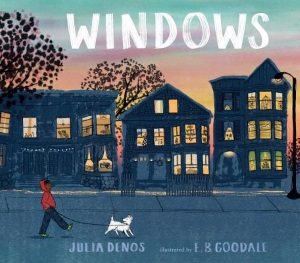 be cheating if, for just a moment, I sent you to Martha’s review of Julia Denos’s Windows, illustrated by debut artist E. B. Goodale? Martha nails a lot of what I like about this story of a brown-skinned boy’s stroll through his diverse neighborhood, as he describes what he sees when the windows light up in the growing dark, including the book’s contemplative tone and the nuanced, atmospheric illustrations.
You can read in this Horn Book Q&A (and even the bios on the book’s dustjacket flap) that the book has a particular connection to a specific spot on the map — Somerville, Massachusetts. The author and illustrator, who are friends, pitched it as a team. (Denos wrote the text with E. B.’s art in mind and then sent it to her in the hopes she’d illustrate it.) They even pitched it straight to Candlewick Press, because Candlewick is also based in Somerville. That’s to say that the book is two women’s love letter to a small town they used to call home.
To be sure, the Caldecott committee is focused on the book in front of them and are not necessarily concerned with the book’s path to publication — but I do find all of it interesting. And I also share all of that to say this: though the book was spawned by affection for a particular town in the northeast U.S., this setting could also be a densely urban town in another part of the country — a neighborhood in Chicago, Nashville, or New York. This universality is part and parcel of the book’s appeal.
This is a carefully constructed text that leaves a lot of breathing room for an illustrator to spin some magic. I wish ALSC would change its rules and give the Caldecott to both author and illustrator (where applicable). I enjoy so much about Denos’s spare writing here — how her choice of second-person voice ushers the reader into the story; how she describes the twilight as “almost-night”; how she puts figurative language to use (comparing the windows of buildings to “eyes in the dusk” and describing the lights in the windows as “a neighborhood of paper lanterns”); and the mesmerizing rhythm of it all, which shines when you read this one aloud. Goodale takes those words and runs with them, extending the text in concrete, understated ways that capture the wonder and discoveries of a night-time stroll amongst people with bustling lives. Who doesn’t want to linger on each spread, peeking in the windows? There’s someone playing a piano. Someone else is rocking a baby. Someone is comforting a friend. Two neighbors communicate through a tin-can phone, the glowing sky illuminating the scene.
I love how the book accentuates the sense of comfort the boy feels, especially knowing the light will be on in his own window when he returns: “Someone you love is waving at you, and you can’t wait to go in.” There’s his mother, acknowledging his return, and they cuddle up to read with their own open window behind them. I haven't forgotten what Jabari Asim wrote back in November at the New York Times about this part of the book: “It’s a reassuring moment in these times, when walking at night in a hoodie can have different, even troubling associations for a child of color.” (And that red hoodie as a nod to Peter in The Snowy Day is just one of the book’s many rewarding details.)
Goodale uses the sunset as a visual anchor for the story. The dustjacket features a beautiful twilight sky, as do the opening endpapers. Take the dustjacket off to see the warm colors of a setting sun. Watch the colors of the sky deepen and glow with each page turn. One house’s windows even have suns in their stained-glass panes. It’s not till the final illustration and endpapers that we see a completely dark sky; those luminescent reds and oranges of a setting sun are the stars of the show here. I especially love how Goodale renders her trees against those glowing skylines — and how, in several spots, she merely loosely outlines an object (such as, cars parked on the side of the road), reminding us that’s it’s not the things, but the people, that matter.
I could go on, but one more thing: I think the book’s thoughtful pacing is probably its most outstanding quality, particularly where line breaks happen and page-turns propel us. I especially like the spread, midway through the book, where we see 18 windows. It invites us to slow down, wonder, and spin stories about what we see in 18 tiny vignettes — before we continue on our walk with the boy.
Whether it gets a shiny sticker or not, I have trouble imagining the Caldecott committee not giving it a great deal of attention and discussion, as it’s quite a remarkable book — a seamless merging of text and art.



RECOMMENDED

Please register with us to continue reading.
ALREADY A SUBSCRIBER? LOG IN
We are currently offering this content for free. Sign up now to activate your personal profile, where you can save articles for future viewing.
ALREADY A SUBSCRIBER? LOG IN
Thank you for visiting.
We’ve noticed you are using a private browser. To continue, please log in or create an account.

Add Comment :-
Comment Policy:
Comment should not be empty !!!
Priscilla
Today I shared "Windows" with a group of 3rd/4th graders in a class where I was subbing. They were captivated. They discussed so many details in the book. The illustrations are so exquisitely detailed. The writing is poetic and worth rereading. I stumbled on this book in a library. I told the students: "I think this book deserved a Caldecott." This evening I got online to see if other people felt the same. Thank you for your thoughtful review, Julie Danielson.Posted : Oct 23, 2018 10:49
Fran Manushkin
I'm wondering that In addition to the nod to Peter in the boy's red hoodie in "Windows," the book may also have been influenced by Ezra Jack Keats' book "Dreams," which includes rows of brownstones with little dramas in each window.Posted : Jan 29, 2018 05:43
Julie Danielson
Interesting, Todd. It gives new meaning to the "you might pass a cat" moment. I suppose it works either way, especially with that final "So you do" right above the dog. Thanks for chiming in, everyone.Posted : Jan 24, 2018 02:08
Todd
In the (overwhelmingly positive) discussion of WINDOWS at Capitol Choices a few months back, a twist that I had not considered in my first two readings was brought up. Is this the boy's story, or the dog's? I mention this because the dog isn't ever mentioned in the review above, but so much of the perspective could be transferred to it.Posted : Jan 23, 2018 06:28
Emmie
Windows tugged at my heartstrings more than any other 2017 picture book. For more than ten years, my mom, sister, brother, and I went on dusky late evening walks around our neighborhood. We rarely missed a night. My favorite activity was peeking into my neighbors windows. I loved looking at the colors of their walls and the pictures and photographs hanging on them. I loved being able to see what they were watching on TV and I especially loved to see people involved in their nightly routines and activities. People existing in their homes fascinated me. In late December, I went for a night jog and found myself still noticing people's windows...old habits die hard. I heard about the concept of this book before reading and was curious to see how it would translate into picture book form. Denos and Goodale masterfully captured a childhood experience and I am so thankful for their insight and wisdom. Windows is perfect.Posted : Jan 22, 2018 04:49