


2018 School Spending Survey Report
From The Guide: Math Picture Books
In “What Makes a Good Math Storybook?”, Audrey M.
 In “What Makes a Good Math Storybook?”, Audrey M. Quinlan explores some “classic picture books that can be enjoyed as works of literature and also to painlessly introduce math concepts to children.” As recent issues of The Horn Book Guide have shown, the math-is-fun picture-book model is alive and well today. The following Guide-recommended books ease young kids into the new terrain of mathematical thinking via engaging story lines, welcoming illustrations, conceptual clarity, and opportunities for participation.
—Katrina Hedeen
Assistant Editor, The Horn Book Guide
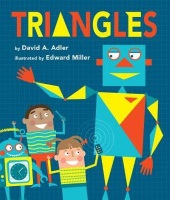
Adler, David A. Triangles
24 pp. Holiday 2014 ISBN 978-0-8234-2378-1
Gr. K–3 Illustrated by Edward Miller. A couple of kids and a pair of robots host this personable introduction to triangles. The usual classroom terms (vertex, congruent, etc.) are presented in bold type and clearly defined; Adler gets readers to live the geometric magic by encouraging them to make angles with their arms and fingers. The flat, bold illustrations are, yes, geometric but not without flair.
Brocket, Jane 1 Cookie, 2 Chairs, 3 Pears: Numbers Everywhere
32 pp. Millbrook 2013 LE ISBN 978-1-4677-0232-4
Gr. K–3 Jane Brocket’s Clever Concepts series. “How many fruits in a row? How many socks in a box? That’s right, seven.” A chipper narrative encourages readers to count numbers one through twenty via gallery-quality color photographs. Brocket has an eye for finding her chosen numbers in fresh places (six flowers stitched into some fabric), but she’s not against setting the stage (a sixteen-cookie tower).
Long, Ethan The Wing Wing Brothers Geometry Palooza!
32 pp. Holiday 2014 ISBN 978-0-8234-2951-6
Gr. K–3 They’re baaaack — and that’s a good thing. The five birdbrained duck brothers return to present three different “amazing feats” of geometry. Each feat features W-centric alliteration and Looney Tunes–esque slapstick via cartoony panels. One feat is not for the faint-hearted: when Walter participates in “Partitioning Rectangles into Two and Four Equal Shares,” he ends up in four equal wedges.
May, Eleanor Albert the Muffin-Maker
32 pp. Kane Press 2014 LE ISBN 978-1-57565-631-1
PE ISBN 978-1-57565-632-8
Gr. K–3 Illustrated by Deborah Melmon. Mouse Math series. Mouse Albert sets out to make muffins (“By myself!”). He finds he’s fresh out of the first ingredient, then the second, third, and so on, but thanks to his neighbors’ generosity, the baking project is a success. Softly illustrated, friendly-looking mice welcome readers to this purposeful but effective primer on ordinal numbers (with a bonus lesson on sharing). Two activity pages are appended.
McGrath, Barbara Barbieri Teddy Bear Addition
32 pp. Charlesbridge 2014 ISBN 978-1-58089-424-1
PE ISBN 978-1-58089-425-8
Gr. K–3 Illustrated by Tim Nihoff. The candy-colored bears from Teddy Bear Counting and Teddy Bear Math return for another rhyming mathematical jaunt. Readers are asked to first sort, then estimate, and finally add together groups of bears; both single- and double-digit addition are explained, as well as how to set up an addition problem. Word bubbles from the teddies give further instruction and more information. Good for classroom use and small-group instruction.
Stills, Caroline Mice Mischief: Math Facts in Action
24 pp. Holiday 2014 ISBN 978-0-8234-2947-9
Gr. K–3 Illustrated by Judith Rossell. “9 mice tidy. / 1 mouse somersaults. 9 + 1 = 10.” As ten mice prepare for their circus, the breakdown of activity shifts from chores to play, cleverly reinforcing how different combinations of numbers all add up to ten. Mixed-media illustrations of cute-as-can-be acrobatic mice are supported by a spare text and a simple equation on each spread, providing an inviting way to introduce basic addition.
Wingard-Nelson, Rebecca Ready for Addition
48 pp. Enslow/Elementary 2014. New ed. (2005) LE ISBN 978-0-7660-4245-2
Wingard-Nelson, Rebecca Ready for Fractions and Decimals
48 pp. Enslow/Elementary 2014. New ed. (2005) LE ISBN 978-0-7660-4247-6
Wingard-Nelson, Rebecca Ready for Multiplication
48 pp. Enslow/Elementary 2014. New ed. (2005) LE ISBN 978-0-7660-4248-3
Wingard-Nelson, Rebecca Ready for Subtraction
48 pp. Enslow/Elementary 2014. New ed. (2005) LE ISBN 978-0-7660-4246-9
Wingard-Nelson, Rebecca Ready for Word Problems and Problem Solving
48 pp. Enslow/Elementary 2014. New ed. (2005) LE ISBN 978-0-7660-4250-6
Gr. K–3 Ready for Math series. Mathphobes may doubt Wingard-Nelson’s promise: “Get ready to discover math…made easy!” Yet her concise explanations, clear examples, helpful diagrams, and clutter-free pages do make for friendly introductions to (or reviews of) math concepts. Illustrations, often humorous, help break up the texts. There’s nothing groundbreaking going on in these updated, retitled editions, but students and teachers will find the volumes useful. Reading list, websites. Ind.
From the January/February 2015 issue of The Horn Book Magazine. These reviews are from The Horn Book Guide and The Horn Book Guide Online. For information about subscribing to the Guide and the Guide Online, please click here.


Added To Cart
RELATED


RECOMMENDED

Please register with us to continue reading.
ALREADY A SUBSCRIBER? LOG IN
We are currently offering this content for free. Sign up now to activate your personal profile, where you can save articles for future viewing.
ALREADY A SUBSCRIBER? LOG IN
Thank you for visiting.
We’ve noticed you are using a private browser. To continue, please log in or create an account.

Add Comment :-
Be the first reader to comment.
Comment Policy:
Comment should not be empty !!!