


2018 School Spending Survey Report

The Horn Book website has lots of material of interest to teachers. Here are some areas to explore. And follow us on Twitter: #lollysclass
|
Interviews with authors and illustrators Recommended books -- reviews and themed book lists |
School -- reading in school, author visits, and more Suggestion box: what else to you want to see in Lolly's Classroom? |
A Kick In the Head | Class #5, 2016
This is one of those books for kids that tends to be an eye-opener for most adults, too.
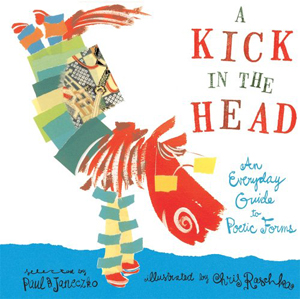 This is one of those books for kids that tends to be an eye-opener for most adults, too. Who knew there were this many poetry forms out there?!
Notice how the book could be enjoyed by just reading the poems. OR, if you want to learn more, you can see what the form is and use Chris Raschka's symbols to help you remember. If you want even MORE, read the super-small print at the bottom of the page.
I hope you will all take time to read Janescko's excellent introduction. He's a teacher himself and knows how to explain poetry in ways that everyone can understand. Why all the rules? Well, would a basketball game be any fun to watch if there were no rules? Same with poetry. But he's also good on why it's okay to break the rules sometimes.
Most of all, I implore you NOT to read this book fast or all at once. If you were sharing this with children, you certainly wouldn't. If you have to read it under time pressure (e.g. on reserve), then try to imagine it being read with children just a little bit at a time.


Added To Cart
RELATED


RECOMMENDED
Please register with us to continue reading.
ALREADY A SUBSCRIBER? LOG IN
We are currently offering this content for free. Sign up now to activate your personal profile, where you can save articles for future viewing.
ALREADY A SUBSCRIBER? LOG IN
Thank you for visiting.
We’ve noticed you are using a private browser. To continue, please log in or create an account.

Add Comment :-
Comment Policy:
Comment should not be empty !!!
Sammie Herrick
I really loved this book. I think it makes poetry both accessible and fun. I know for a lot of my younger students, poetry is their least favorite unit in English. I think if they were offered more books like this, it wouldnt be. The bright illustrations really helps to make the book captivating. I also love that the text moves around each page (like on page 39 when the poem is shaped like a person!) I like that it gives examples of each kind of poem, so students can see the difference. I think often times students think of poems as one homogeneous thing, but this book proves just how different each poem can be. I think it could definitely inspire students to want to write their own poems.Posted : Apr 27, 2016 03:16
Joanna Craig
I loved reading "A Kick In The Head" because I love reading poetry, but also because the author did such a great job of explaining why there are so many forms of poems with a wide variety of rules. When I write my own poetry, what I love most is sticking to the rules and having that challenge as I choose the words. I think it also gives readers of poetry something extra that they can latch on to - if they do not know the words, or if they do not understand the topic, at least they can recognize the rhyming or the format or the sound of the poem. This book did a great job of adding illustrations to the poems specifically for those listeners who may not be reading yet. The reference pages at the end of the book seem especially useful for teachers or parents who might not know all of this information, but can read it before presenting this book to their students or children. Additionally, I think this book offers a way for people to use poetry in the classroom, perhaps by having children get started writing a poem about an image that they have drawn.Posted : Apr 26, 2016 05:19
Dominique Donette
I loved this book! I plan to buy it for my little sister. She has a mild speech impediment and enjoys poetry. This will be a challenge for her but it'll be a great read aloud option with awesome images to inspire her to keep turning the pages!Posted : Apr 26, 2016 03:50
Marty Ray
For someone who studied English Literature in college, I've always wondered if there was a ready reference for every different kind of poetry that exists. I finally found it. This was one of those books, which provides almost equal enjoyment, information and entertainment to children and adults alike. The style of the book and the illustrations, as mentioned above, are bright and cheerful, making the study of poetry fun and accessible, not dour or boring. Personally, I really enjoyed April Wayland's version of Shakespeare's sonnet number 12 alongside the original.Posted : Apr 26, 2016 12:46
Elizabeth Dorr
For someone who has never really enjoyed or been interested in poetry, I loved this book! I found it quite accessible to both children and adults alike, and I could easily see this being used in a classroom setting to teach about different types of poetry, creative writing, art, etc. I especially loved the illustrations, which were so beautiful and bright; I almost wanted to frame them. One little touch I also appreciated was the small blue symbols for each type of poem that were so simplistic but truly conveyed the spirit of each type of poem. I think those are a nice way to engage different types of learners as well. Finally, I am curious as to why Janeczko chose to use the poem "A Kick in the Head" as his title, any thoughts?Posted : Apr 25, 2016 05:17