|

Talks with Roger is a sponsored supplement to our free monthly e-newsletter, Notes from the Horn Book. To receive Notes, sign up here.
Sponsored by
Feiwel & Friends, an imprint of Macmillan Children’s Publishing Group
The Leaving Room doesn’t start with much—a girl in a room talking to herself. But I knew, from interviewing Amber McBride about Gone Wolf, to trust that nothing was necessarily as it seemed.
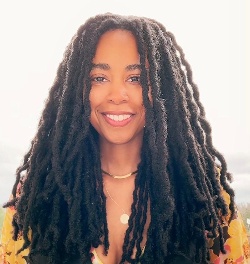 Roger Sutton: I like how, as you did in Gone Wolf (which we Talked about), you just sort of fling readers into the middle of a story. We’re so used to—and particularly in books for young people—getting a lot of who, what, when, where, and why in the opening pages. Roger Sutton: I like how, as you did in Gone Wolf (which we Talked about), you just sort of fling readers into the middle of a story. We’re so used to—and particularly in books for young people—getting a lot of who, what, when, where, and why in the opening pages.
Amber McBride: I’m just like, “Ta-da! Let’s start.”
RS: And here I am, as the reader, in this room with this girl and she’s talking. How do you trust your readers to keep going?
AM: That’s a good question. I think being a college professor helps. I taught writing classes for ten years to kids right out of high school. They're still very young. And what I learned was that they are so much more intuitive than people give credit to young people. We think we have to hold their hands through so many things, but in reality they are ready to go on a ride. They’re ready to try it out. And for me, when I was younger, I remember thinking that books that were like “and this is exactly how it happened” were not my favorites. I liked books where you’re dropped into this dystopian place and you don’t know exactly what’s happening but you’re piecing it together. I think I just trust readers. Hopefully I write well enough that if they don’t fully understand, they’ll be curious enough to keep going, and if not, then that’s okay, they can step away and be like, “This isn’t for me right now.” The poet John Skoyles taught in my MFA program at Emerson College, and he often said, “You probably should be starting a poem about three lines past where you think, because nobody really cares about those first three lines.”
RS: Oh, interesting.
AM: Those first three lines are for you, the poet, to understand the poem. I think about that a lot with my books: Were those first three pages needed, or were those to orient me as a writer? Where does the story actually start? That’s the question I’m always pushing against.
RS: Good for you. You even take a while to introduce a second person into the story.
AM: I think that was the nature of this story. Gospel, the main character, thinks she’s the only Keeper of these things called Leaving Rooms, and so we had to establish her in her Leaving Room before we could bring in the next person, Melodee. To say, “Oh wait, are there hundreds of Leaving Rooms? How is this working? What is the magic happening here?” The challenge with this book, unlike with Gone Wolf, was one, it was in verse—so much shorter. And two, “Can I keep a book interesting with just one person in a room talking to themselves and readers for almost the first two-thirds or so of the book? Is that going to work?” So it was a lot, skill-wise and craft-wise, of going back to things I learned in grad school. How am I going to make this work? How can I make this interesting on the page? How can I make each of the children sound different? It was a challenge not having another adult or an older character there to talk for a little while.
RS: And I wondered too if we now have a generation of young readers for whom verse novels are an established form. We didn’t see those till, say, thirty years ago. They were new. Now at least two generations of kids have grown up with them, so they maybe lessen their expectations.
AM: There’s also so many different types of verse, as you said. So readers are used to that. But also I think this idea of what we even put onto poetry is changing. There used to be a pretentiousness around poetry. And now rap music can be considered poetry, lyrics can be considered poetry—and so I think that entry point into poetry is not such a brick wall. It’s not Shakespeare, you know what I mean? Which I think can make young people want to interact a bit more with it. I was just talking to my agent about how we have a lot of novels in verse for young people, but there are very few novels in verse for adults, which is interesting because you would think that they would want more poetry.
RS: When verse novels became a thing in young adult literature, there was always a contingent who claimed it was dumbing down books.
AM: Which is hilarious to me, because it was much easier for me to write in prose for Gone Wolf than it was to write this book. Any verse novel I do is harder, because the economy of language means that I have to put what would be two pages of dialogue into six lines of verse. And: How am I getting to the essence of that conversation? How are these metaphors working? And are you stacking metaphors? Is this working metaphorically on several levels? I think a lot of verse writers can write prose, but not a lot of prose writers can write poetry.
RS: Well, to be fair, I do remember verse novels where I thought, If I just removed these line breaks, it’s not really going to be that different.
AM: I love that you said that, Roger, because I feel that too with some verse novels I see. And that’s what I mean when I say it has to be intentional. It shouldn’t be like, “If you take away those line breaks, it could be prose, and nobody would tell the difference.” Those writers aren’t poets, and they haven’t studied poetry.
|
RS: Whatever possessed you to get an MFA in poetry anyway? Brave girl.
AM: I wasn’t planning on it. I was pre-med in college and then this whole situation happened. I was in a small car crash and had to go to the hospital, and I realized, “I don’t like hospitals. I don’t think I want to spend the rest of my life in them.” But I had always loved poetry. And I loved writing, but I was never taught that you can make a career out of writing. I was in my junior year of college when I got into that accident. I had been taking English classes for fun in between pre-med classes. I was always overloading my schedule and thankfully I already had a lot of credits. I had to tell my parents that I wanted to switch my major from pre-med to English with a minor in creative writing and African Studies.
RS: How'd that go, Amber?
AM: That was an interesting conversation. My parents were paying for college, but I have really great parents. My mom was like, “Write me a ten-year plan of how this works, and we’ll think about it.” So I spent the weekend writing a ten-year plan, how I was going to be a professor and how I was going to do this course of study and get a scholarship. I’m lucky to have really supportive parents. They were like, “All right. Put the paperwork in.” And the rest is history. I got into grad school, went to Emerson College, finished in two years instead of three, and started teaching that next year. It was a whirlwind. But I had really good poetry professors, specifically John Skoyles, who helped me grow as a poet in a way that I didn’t realize I could. I feel very grateful for my professors there.
RS: Well, you certainly do surprising things with this verse novel. And you did this to me the last time, Amber, where I thought I'm reading one story and then I’m reading another story completely.
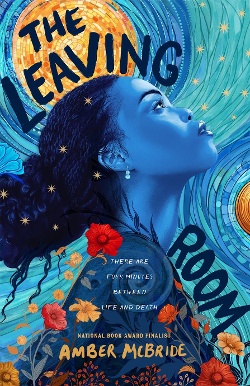 AM: This is why I was excited to talk to you, because I feel like I did that, and I was wondering how you were going to feel about this little twist at the end. The unexpected thing. Books so often seem so logical when, in reality, life is strange, right? I was talking to my dad about near-death experiences. He’d had one, and I thought, What if there's this place that people who have near-death experiences are creating? And so it became this whole "what if, what if, what if." I just kept following that “what if,” and the Leaving Room and Gospel came to me. But yeah, it was one of those books where I knew from the beginning what the end was going to be. With Gone Wolf, I knew it was going to go somewhere else, but it wasn’t one hundred percent. With this one I knew from the beginning where I was going, which was a new writing experience for me. AM: This is why I was excited to talk to you, because I feel like I did that, and I was wondering how you were going to feel about this little twist at the end. The unexpected thing. Books so often seem so logical when, in reality, life is strange, right? I was talking to my dad about near-death experiences. He’d had one, and I thought, What if there's this place that people who have near-death experiences are creating? And so it became this whole "what if, what if, what if." I just kept following that “what if,” and the Leaving Room and Gospel came to me. But yeah, it was one of those books where I knew from the beginning what the end was going to be. With Gone Wolf, I knew it was going to go somewhere else, but it wasn’t one hundred percent. With this one I knew from the beginning where I was going, which was a new writing experience for me.
RS: And did you know—I mean, this was another surprise, and I don’t want to give away too much about the book—that we’d get a romance halfway through? Was that planned from the beginning?
AM: It was, because for me, without sounding like a cliche, I think that so much of what we do—and I don't just mean romantic love—is out of love. Even the recipes in the book, that's love. Those are my actual family recipes. When you love someone, you cook for them. When you love someone, you want to remember them. The idea that these two girls would be fighting so hard was a lot to do with their love for each other. So it was always going to be a love story. As a queer woman who's written what people would assume are straight-presenting characters in the past, I really did want to write a book that was quintessentially and openly queer, because I didn't see as much representation specifically for Black women in that aspect. And so yes, there was going to be a romance, but it's a romance where they clearly are close friends and also love each other. It’s a very complicated and deep kind of romance. It was always the plan for Melodee and Gospel. And then you find out later...
|
|
RS: Don’t give it away!
AM: Never mind.
RS: In the front of my copy of the book, it says something about how the story takes place in the course of four minutes.
AM: Yes.
RS: Which is wild.
AM: Yes.
RS: Do you want people to know that before they start?
AM: Well, we know there is a countdown going on, but we don’t learn what it is for until later. One thing I learned from Gone Wolf and Me (Moth), which also has a twist, is that people who want to know more are going to know more before they read the book anyway. They’re going to look around. And then there are people who go in and they’re like, “Let’s go.” Hopefully, books work either way. There’s a reason why it’s four minutes, which...once again, no spoilers. When I was talking with my editor about where we were going to put that information, she thought it was really important to put up front, even on the cover. I think the cover says something about four minutes. There’s a quickness to it. Also, even when you start reading a book and you know what’s supposed to happen, you can get so into the book that you forget the thing you knew.
RS: Yes. And what that four minutes will mean in terms of the story.
AM: Exactly, exactly. Since there is that little countdown. In the audiobook there's a ticking sound that they put in as well. Elishia Merricks is the amazing audiobook producer who does that. I just heard it recently. It's really thought out. They do such a great job over at Macmillan with that kind of stuff.
|
|
RS: Are you nervous about publishing a queer novel in this current moment?
AM: I wasn’t nervous while I was writing it. A little more nervous now, maybe. It’s a different world from when I was writing it. I don’t think nervous is the word. I think that I hope that it gets into the hands of the people who need it. I worry about that. But I feel like Gone Wolf gave me a good introduction to people who were going to be mad at you about something. So I'm just excited for it to be in people's hands. I hope that there's no unnecessary banning or anything like that. But you never know.
RS: I mean, I don’t mean to make you anxious. I think the thing to worry about is librarians and teachers who say, “This looks really good, but I could get in trouble—maybe just make this disappear and not buy it in the first place.”
AM: That’s their decision. That’s unfortunate because, as we know, some of the kids who need books the most only have access to books through libraries. Their parents are not able to buy books. So that's the real worry. But there are public libraries you can have access to. I'm always reminding my students about the New York Public Library—almost anybody can get a library card there. And so I think that supporting those places that do carry your book is the best you can do, because there's always going to be something that people don't like about your book. Queerness not being acceptable is very strange to me because it’s just a human experience. I feel like there are a lot more dangerous things we should be a bit more worried about.
RS: You would think, wouldn't you?
AM: You’d think. But that's not the case. I guess the best thing we all can do is just authentically be ourselves and hope that the right people find the book and find you.
RS: Did you ever read Ruby by Rosa Guy? It’s a young adult novel from the mid-1970s about two young Black girls falling in love.
AM: No, but when you say a book like that was written then, I’m like, “Well then, in this time I should be fine. I should be good because when that was an even more dangerous thing to do, someone did that.” So that makes me feel even more respectful toward the people who had to be brave and really were putting a lot on the line when they wrote those books.
|
|
RS: And now you have queer comrades, too, who are writing books. So you don’t have to convey the entire Black woman queer experience in one novel.
AM: We can have lots. We can have more. There’s nuance to it. Everyone has a different experience. I think that we need to make room for all Black experiences in general. And I like that we’re trying to create that more and that it feels like that’s what’s happening in literature, because it is vast, just like any other experience.
|
Sponsored by
Feiwel & Friends, an imprint of Macmillan Children’s Publishing Group
|









Add Comment :-
Be the first reader to comment.
Comment Policy:
Comment should not be empty !!!