



2018 School Spending Survey Report
Won't You Miss the Polar Bears?
In August of 2024, Illinois passed HB 4895, a bill mandating climate education in public high schools by the 2026–2027 school year. Four other states (NY, CA, CT, NJ) already mandate climate education in their schools. Recent surveys, however, show that the majority of U.S. teachers don’t teach climate change in part because they don’t feel prepared to do so. For example, according to a nationally representative EdWeek Research Center survey of 538 K–12 teachers in December 2022, “Three-fourths of teachers have not received any professional training or education on how to teach climate change.”
In August of 2024, Illinois passed HB 4895, a bill mandating climate education in public high schools by the 2026–2027 school year. Four other states (NY, CA, CT, NJ) already mandate climate education in their schools. Recent surveys, however, show that the majority of U.S. teachers don’t teach climate change in part because they don’t feel prepared to do so. For example, according to a nationally representative EdWeek Research Center survey of 538 K–12 teachers in December 2022, “Three-fourths of teachers have not received any professional training or education on how to teach climate change.” The North American Association for Environmental Education, in an overview of their 2022 study of 707 teachers, cites “a confidence gap on the teacher side” as one of the primary issues preventing climate change education. That’s understandable: for one thing, climate change can be shared badly, promoting climate anxiety rather than engagement and action.
Still, shouldn’t young kids know the truth about climate change? But, on the other hand, shouldn’t they also be free from the anxiety that older siblings, teachers, and parents might experience around this topic?
The reason to work to mitigate anxiety in kids (and in the rest of us) is that anxious people tend to be less likely to act; instead, anxiety leads to withdrawal and ecophobia. Acting in a group on a climate issue helps to mitigate climate anxiety. By 2050 — the critical year for reaching net zero carbon emissions — the kids we’re raising now will be adults in their thirties. They deserve to learn now about addressing climate change as a cool group project rather than as a thankless job.
 How can those in the children’s literature community help? Established in 2020 by the Evanston (IL) Public Library, the Blueberry Awards Committee includes librarians, teachers, library paraprofessionals, a biologist, children’s book authors, an international birder, a master gardener, nature educators, specialists in child development, and sustainability managers. Since 2021, the committee has named the year’s best nature and climate books for ages 3–10+ and has been creating a workable set of criteria for selecting books that avoid provoking climate anxiety. (Separate criteria evaluate books on quality, diversity, and scientific accuracy.) Using primary research for the benefit of therapists by Professor Louise Chawla into the extent and type of climate anxiety experienced by kids and how best to relieve it (University of Colorado, Boulder; Children and Nature Network’s Scientific Advisory Council), we came up with a list based on our understanding of her conclusions about helping children navigate climate information safely and extrapolated a list of rules for relieving climate anxiety:
1. Share love of nature first, climate action second.
2. Recommend group action, not acting alone.
3. Include practical suggestions for kids to mitigate the actual problem shared in the text.
4. Indicate that adults are already engaged. If needed, state or imply that governments and multinational corporations bear more responsibility than does a child. Never say, “It is up to you or young people alone.”
5. Follow child development guidelines about what kind of information kids can handle at which age.
The Blueberry Committee believes in telling children the truth about climate change, but the approach should vary by age. Of course, each child is unique, but we wanted a simple yardstick to start our evaluations. The general adage we use is, no doom and gloom before third grade. Jean Piaget’s theory of the stages of cognitive development posits that before this age most kids don’t have the logical thinking ability to process future threats. Engendering a love of nature is the most important approach for all of us, but especially for kids seven and under, because of the idea that we work hardest to save what we love. Local problems with local solutions are generally best for this age group. Global discussion of climate change peril should usually wait until age eight and up, and it should be leavened with information about adult involvement and past successes. The deep science of climate change should be saved for middle school and above.
For example, to teach children about supporting birdlife:
For kids younger than eight: “The birds in your yard need caterpillars to feed their babies in the spring, but caterpillars hatch only on native plants. Goldenrod supports more than one hundred species of native caterpillars! Let’s plant some goldenrod together.”
For kids eight and up: “There’s a large drop in the number of birds we’d expect to see in the U.S. right now, due in part to the dramatic loss of native insects. Popular movements like Homegrown National Park are already working to plant native plants such as oak and goldenrod that support large numbers of insects. The good news is that, given native plant hosts, the insects rebound! Let’s find ways to help insects and birds together.”
* * *
Here are some recent Blueberry Award winners that the committee prized for many reasons, including meeting our Anti–Climate Anxiety Criteria.
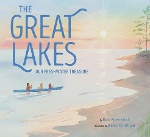 The Great Lakes: Our Freshwater Treasure (Knopf) by Barb Rosenstock, illustrated by Jamey Christoph (4–8 years), won the 2024 Blueberry Award. This book shares how precious the five lakes are as a group alongside historical information about glaciers and more. Did you know that freshwater makes up only one percent of the easily accessible water on our planet? (Another two percent stays frozen in glaciers.) Did you know that if we released all the water from the Great Lakes, the continental U.S. would be covered with nine feet of fresh water? This book sparks wonder and even amazement. The author ends by recommending that kids work with existing groups trying to safeguard the Great Lakes and make sure that their elected officials know that they care about these important bodies of water. This book meets criteria one and five handily, as well as having beautiful (and accurate!) art.
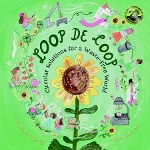 Loop de Loop: Circular Solutions for a Waste-Free World (Groundwood) by Andrea Curtis, illustrated by Dutch artist Roozeboos (6–9 years), was one of four 2024 Blueberry Changemaker Award winners. The award recognizes books for “outstanding achievement in rallying kids to climate action.” Curtis contrasts a linear economy (extract, create, buy, use, discard) with a circular one (extract, create, buy, use, reuse and/or recycle, and use again). A circular system echoes nature: the sun’s cycle, the seasons’ cycle, the water cycle, composting, and more. She presents waste as a problem but does not trace the full devastating effects. Instead, she gives a tour across the world of some remarkable successes in the circular economy, called the “loop de loop world” in the book. At the end, kids are introduced to great ways for families to participate: toy rentals, repair cafés, tool libraries, reselling clothing, all of which will reduce the amount of stuff we throw away. The art is sweet and engaging. This book meets each of the criteria really well while still sharing the truth in a way that takes kids’ emotions into account.
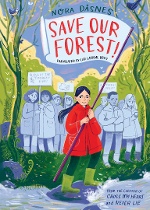 The graphic novel Save Our Forest! (Hippo Park/Astra) by Nora Dåsnes, translated from Norwegian by Lise Laerdal Bryn (10–12 years), is another 2024 Blueberry Changemaker Award winner. It’s about a group of diverse middle school kids in Norway who lobby their town and school against removing a wetland forest to put up a school parking lot. When Dåsnes shares difficult global climate facts with kids, the scene is part of one character’s emotional catastrophizing, adding to the reader’s understanding of the main character. The committee was especially pleased with the story arc, in which the kids first exclude their parents from their activism, as frustrated teens and preteens might do, but ultimately work together as a group of parents, kids, and engaged community members. Collective action makes the difference. The book ends with a guide to activism and an assurance that no one is alone in their worries and concerns; this movement is already a group effort that wants more partners.
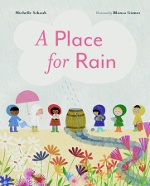 A Place for Rain (Norton) by Michelle Schaub, illustrated by Blanca Gómez (4–8 years), is also a 2024 Blueberry Changemaker Award winner. It starts with a big rainstorm; the problem is the flooding and resulting pollution when rain picks up oil and garbage along the city streets. A preschool class decides to help with the “mess.” First, they put a rain barrel on their building, and then they construct a rain garden in the lawn down from the rain barrel to deal with the overflow. Schaub presents it as such a logical and doable project. This is a perfect example of empowering younger kids to take local action that makes a difference.
* * *
Our children should have the chance to read nature and climate books with the most fascinating science, the clearest and most beautiful writing, and the most engaging art and photography. They should get to hear all the eco-scientific successes we’ve had globally. They should learn about the diverse scientists called to this work now and in the past. Luckily, a glorious explosion of brilliant nature and climate books is being created by Blueberry Award–winning authors such as Lori Alexander, Micha Archer, Nikki Grimes, Amy Hevron, Jay Hosler, Bret D. Huson (also known as Hetxw’ms Gyetxw), Dana Alison Levy, Brittany Luby, G. Neri, Patricia Newman, Anita Sanchez, Melissa Stewart, Linda Booth Sweeney, and so many more.
As members of the children’s book ecosystem, we need criteria like those put forth by the Blueberry Awards Committee to support curious kids without compromising their mental health. It’s never been more important to get this right, since the need to act is so pressing.
From the November/December 2025 issue of The Horn Book Magazine.


RECOMMENDED

Please register with us to continue reading.
ALREADY A SUBSCRIBER? LOG IN
We are currently offering this content for free. Sign up now to activate your personal profile, where you can save articles for future viewing.
ALREADY A SUBSCRIBER? LOG IN
Thank you for visiting.
We’ve noticed you are using a private browser. To continue, please log in or create an account.

Add Comment :-
Be the first reader to comment.
Comment Policy:
Comment should not be empty !!!