


2018 School Spending Survey Report

The Horn Book website has lots of material of interest to teachers. Here are some areas to explore. And follow us on Twitter: #lollysclass
|
Interviews with authors and illustrators Recommended books -- reviews and themed book lists |
School -- reading in school, author visits, and more Suggestion box: what else to you want to see in Lolly's Classroom? |
Books that inspire community
Lately — and by accident — I’ve been reading Spanish versions of many French-authored children's picture books.
 This prompted an informal search for other books that would have the same underlining message. For example, Pedro y la Luna by Alice Brière-Hacquet and Célia Chauffrey is about a boy who wants to bring the moon to his mom. To do so, he has to involve his entire community and beyond. Then there is the Portuguese story O Grande Rabanete by Tatiana Belinky. In it, a grandfather decides to plant radishes and progressively needs help with the harvest because of the radishes' large size.
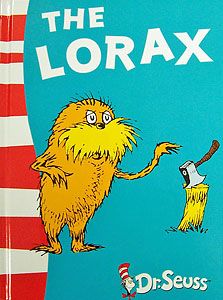 I then tried to think about other books that send the message of doing things together for a common cause and couldn’t think of many other than the classic stories “The Pied piper of Hamelin” and “The Little Red Hen.” In the 1990s there was The Rainbow Fish by Swiss author-illustrator Marcus Pfister. A fish with the shiniest scales in the sea refuses to share his wealth and then becomes lonely. He rediscovers community only once he shares his scales. And of course, there is also The Lorax by Dr. Seuss, a book published in 1971 that depicts what happens to a verdant land when the “Once-ler” chops down all the truffula trees and drives the (Seussian) animals away. The last hope to rebuild the environment — and the community — is for a boy to plant the last remaining truffula tree seed.
 So much of children’s literature, especially today, is about common things that happen to kids, such as the boy a lost his bear and found it swapped in the forest in Where’s My Teddy? by Jez Alborough, or the boy who misbehaves with his mom in No, David! by David Shannon, or the classic Alexander and the Terrible, Horrible, no Good Very Bad Day by Judith Viorst. The list is endless.
All this made me think about the often repeated phrase, “literature is life.” So, are these books a reflection of our society? Are children’s books in other societies a reflection of a more “communal” (we) society instead of a more self-centered (me) society? Or is it that younger children relate better to stories that have more of a personal narrative tone? Can anybody think about books that transmit this message in their original languages?


Added To Cart
RELATED


RECOMMENDED
Please register with us to continue reading.
ALREADY A SUBSCRIBER? LOG IN
We are currently offering this content for free. Sign up now to activate your personal profile, where you can save articles for future viewing.
ALREADY A SUBSCRIBER? LOG IN
Thank you for visiting.
We’ve noticed you are using a private browser. To continue, please log in or create an account.

Add Comment :-
Comment Policy:
Comment should not be empty !!!
Lolly Robinson
Thanks for this, Armida. I think here in the US we tend to be kind of anti-message -- or at least anti-OBVIOUS-message. There are plenty of hit-you-over-the-head message books that are not well received in review journals. They also tend to be less popular with children but are easier for some adults to digest.The message books that get positive critical attention are the ones that cushion their blows with humor (like No, David!) or animals (like That New Animal by Emily Jenkins).Posted : Sep 16, 2014 03:58