


2018 School Spending Survey Report

The Horn Book website has lots of material of interest to teachers. Here are some areas to explore. And follow us on Twitter: #lollysclass
|
Interviews with authors and illustrators Recommended books -- reviews and themed book lists |
School -- reading in school, author visits, and more Suggestion box: what else to you want to see in Lolly's Classroom? |
Books in Spanish: A problem of access?
When working as an elementary teacher in the United States, I found it hard to find original children’s literature in Spanish language — books originally published in Spanish, that is.
As a fourth-grade public school teacher in a dual-immersion and bilingual transitional programs in Colorado and North Carolina, it was difficult to try to read books originally written in English and translated into Spanish. Publishers had made the effort to translate some widely known, classic titles such as Where the Wild Things Are (Donde viven los monstruos) or Goodnight Night, Moon (Buenas Noches, Luna). It initially seemed like this could be a good thing because the children already had the background knowledge for making connections to these books. But the reverse happened when they were read in class.
The children didn’t much like the Spanish version for the same reason it’s hard to read a translation of a Pablo Neruda poem or a Mario Vargas Llosa novel in English. As a native Spanish speaker, even the children could hear the forced pace and tone in the Spanish version. “It sounds funny,” they’d say. In the end, I resorted to testing the limits of airline weight restrictions and carried books in my suitcase back from trips made to Latin America or Spain.
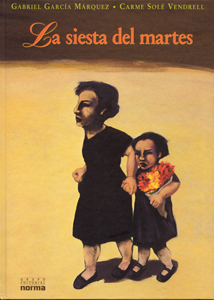 There were several examples of in-class success, such as La siesta del martes by Gabriel García Márquez. Though not known as a children’s author, a Spanish-language editor made the short story available in a children’s edition. The text was unchanged and illustrations were added. It was a hit! The story takes place over the course of one day and was ideal for teaching the use of time in a writer’s workshop. Students were engaged and motivated and most importantly they used connectors and adjectives to establish time in their writing. Students in my classroom were fifty percent native English speakers and fifty percent Spanish speakers.
There is a rich children’s literature in Spanish-speaking countries and there are several large publishing houses in Spain, Argentina, Mexico, and Colombia. Testament to this is the merger between Carmen Balcells, literary agent for many of the Spanish-language’s greatest writers over the past half-century, and the New York-based Andrew Wylie agency. There would be nothing better than using original literature to teach our kids instead of giving them translations or versions of literature in English.
Is this an issue of know-how — affecting demand for original literature in the United States — or an issue of access? After all, as I learned lugging books from Latin America and Spain, the problem of access was significant, as evidenced by the Balcells-Wylie merger. Then again, maybe the access wasn’t there because the demand wasn’t large enough to merit paying for the copyrights. I don’t know. Perhaps one day soon we will find out.

Added To Cart
RELATED


RECOMMENDED
Please register with us to continue reading.
ALREADY A SUBSCRIBER? LOG IN
We are currently offering this content for free. Sign up now to activate your personal profile, where you can save articles for future viewing.
ALREADY A SUBSCRIBER? LOG IN
Thank you for visiting.
We’ve noticed you are using a private browser. To continue, please log in or create an account.

Add Comment :-
Comment Policy:
Comment should not be empty !!!
Elena
Distribution is a big problem among all Spanish speaking countries also, and between Latinamerica and Spain. There are many independent publishers of children books that are doing a great job, but it is not so easy to buy them outside their countries. But if you are looking for good books from Spain and Latinamerica, check out the Cuatro Gatos Foundation, a non-profit based in Miami. They have a great website, in Spanisch and English, and every year they give an award to 20 books in 4 different categories. This is only part of their cultural activities, they organise school visits with authors, a book festival, etc. There are many more ressources out there, but this is definitely a good place to start. And they are based in the US, that should make things easier. https://www.cuatrogatos.org/premio.phpPosted : Oct 09, 2018 09:12
Melissa Herrera
I totally agree! When I was trying to learn Spanish I wanted to READ interesting/fun things in both languages but that translated well! I am working on beginner/intermediate books for English/Spanish learners. I would love your feedback as your are experts in this area! Check out my website if you would be so kind!Posted : Apr 14, 2015 07:24
Debra
We suffer with a similar issue in our work in Central America. Here, it's easier to get access to books translated into Spanish than access children's books originally written in Spanish. We notice that especially at the emergent and early reading levels, the lack of locally relevant content is a real problem.Posted : Jul 25, 2014 05:57