


2018 School Spending Survey Report
Caldecott 2014: The Year in Pictures
Welcome to Las Vegas! City of lights, city of sin; of excess, exploitation, and glitter.
Why else is over-the-top Las Vegas the right spot for this particular Annual conference? Because picture books put on quite a show this past year. We had, as Freeman puts it, an “embarrassment of picture book riches.” Rhymed books for the very young and sophisticated wordless books; fiction, biography, and nonfiction; quiet, intimate books and bold spectacles; humorous larks and elaborate world-building — there was something for everyone, and each book had its passionate supporters, regardless of its perceived chances of winning the Caldecott.
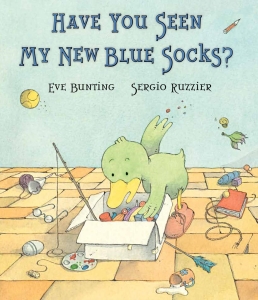 Picture books aimed at the youngest readers; or small in scope and domestic in setting — these books often seem to be overshadowed at Caldecott time by their bigger, bolder, splashier brethren. Have You Seen My New Blue Socks?, written by Eve Bunting and illustrated by Sergio Ruzzier, certainly doesn’t — and didn’t — scream Caldecott, with its quirky art and contained story about a little duck too sweetly clueless to find his own socks. But for my money it has true child appeal, age-appropriate humor, and a successful interdependence between words and pictures.
 A quiet book that was perhaps too understated for the typical Caldecott profile is Building Our House by Jonathan Bean, in which a family of four together build a house from the foundation up — and end up with not just a house but a home. With its kid-friendly subplots seen only in the art and seamless pairing of form and content, Building Our House built a devoted fan base this year.
 Yuyi Morales’s Niño Wrestles the World is far from quiet, but it did present a challenge to the Caldecott norm with its combination of Spanish and English onomatopoeia (“WHUNK BLOOP KRUNCH ¡Ay mis hijos!”), fantasy and reality, and basis on two aspects of popular culture — comic books and lucha libre wrestling — that may not be universally familiar. But Niño wowed fans with its humorous, expressive illustrations, exuberant action, and that brilliant segue from Niño’s imaginative play to real life (i.e., his sweet capitulation to his toddler twin sisters).
 Then there was a book that seemed to have Caldecott written all over it: Peter Brown’s Mr. Tiger Goes Wild, in which a citified tiger searches for a way to express his inner wildness. Bold in conception and execution, full of action and humor and color, with carefully orchestrated page turns and pacing, this book was solidly in the Caldecott wheelhouse. It also had bookmaking chops — including a textured cover underneath the paper jacket revealing close-up tiger stripes (“Underneath, aren’t we all a little wild?” asked one commenter on the Horn Book blog Calling Caldecott) — and hinted at homage (to the classic Where the Wild Things Are).
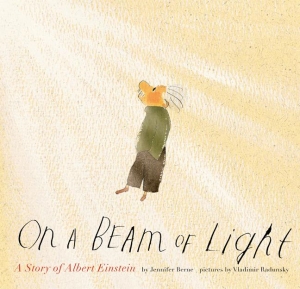 But if Mr. Tiger did not make the Caldecott cut in this remarkable picture book year, neither did many other vaunted contenders: On a Beam of Light: A Story of Albert Einstein, written by Jennifer Berne and illustrated by Vladimir Radunsky; The Mighty Lalouche, written by Matthew Olshan and illustrated by Sophie Blackall; Parrots over Puerto Rico, written by Susan L. Roth and Cindy Trumbore and illustrated by Roth; The Dark, written by Lemony Snicket and illustrated by recent Caldecott darling Jon Klassen; A Splash of Red: The Life and Art of Horace Pippin, written by Jen Bryant and illustrated by Melissa Sweet; and Gene Luen Yang’s paired graphic novels Boxers and Saints (will Hugo Cabret forever stand alone?).
 Of the four books the committee did choose, Honor Book Flora and the Flamingo by Molly Idle — about a little girl whose pas de deux with a reluctant flamingo presages the beginning of a beautiful friendship — is perhaps the most unconventional choice. In a publishing world where full-color is the norm, the book’s minimalist pink-and-yellow color scheme is a bold departure; and its use of flaps to provide motion, extend the action, and reveal humor pushes the limits of the picture book form. With Flora, Idle attempts to present the picture book as a dance — and succeeds. I particularly appreciate how thoroughly the two dancers’ personalities and emotions are communicated through the body language and facial expressions; how the distance between them disappears (literally: they begin on separate pages and end up on the same page) as they find joy in dancing together.
 David Wiesner’s Honor Book Mr. Wuffles!, featuring a cat outwitted and outmaneuvered by an unusual alliance of tiny aliens and ants, feels like a departure for the much-accoladed artist in its graphic-novel feel and in the level of detail in the panel art. It’s also really, really funny, from the multicolored lettering on the cover (and the exclamation point in the title) on. The real-world setting is so well established, through Mr. Wuffles’s essential cat-ness, that we believe unquestioningly in the presence of the alien ship and the subsequent battle. The lightheartedness overlays some fairly weighty themes: it’s all about civilization and art and cooperation between peoples; it’s also a modern-day, sci-fi David and Goliath tale. The compelling illustrations reward close observation: the one huge Cheez-It that sustains the troops; the universality of the photographer’s “say cheese!” (and how to say it in both alien and ant languages). All documented, afterwards, in a new Lascaux-cave-painting-like mural: the defeat of the cat, captured for the ages.
 Honor Book Journey by Aaron Becker is another paean to art and imagination. It’s undeniably and sumptuously gorgeous and a compelling (wordless) story: we relate to the main character because we know how how dull her existence is and what her red-marker-enabled adventure means to her. Much has been made of the influence here of Harold and the Purple Crayon, but there’s also a clear debt to Where the Wild Things Are (as the opening small, square confined pictures give way to full-bleed double-page spreads) and to The Wizard of Oz (as the pages bloom into Technicolor). It’s a first book that already feels like it has a lot of history behind it.
 And now to the spectacular Medal winner, Brian Floca’s Locomotive. It’s hard to argue with the committee’s decision to name it the most distinguished picture book of the year. I think blogger Julie Danielson (Seven Impossible Things Before Breakfast) put it best when she noted its unique combination of the epic and the intimate — with Floca managing, in one cohesive whole, to both present the history of the American transcontinental railroad and tell a personal story of one family’s 1869 journey from Omaha to Sacramento. It’s an edifice of a book, a conceptual structure, seamlessly related to the topic — but one that feels immediate, thanks to the family element. Also seamless is the incorporation of Floca’s meticulous research into the story, both in words and pictures (and see the contrast between the paper jacket and the cloth cover for a devastating statement about the human and ecological costs of the coming of the railroad). I would argue that no book last year did page turns better than Locomotive. Whether it’s the angle of the track or the anticipation on a character’s face or the placement of the text — Floca’s use of page turns powers his book the way the engines propel the trains across the American West. And his perspectives will take your breath away.
When Caldecott committees meet behind those closed doors to make their choices, they are occupied entirely with debating the merits of individual books. It’s only when it’s all over and the dust settles that the committee — and the rest of us — can see the big picture. And from that perspective we can make a few observations about this year’s group of winner and honorees.
When nonfiction wins the Caldecott Medal, it’s generally biography; Locomotive is the first ever work of nonfiction history to win the Caldecott since the very first Medal was awarded in 1938 to Animals of the Bible. Floca is also just the second author-illustrator (after Peter Sís) to win both Sibert and Caldecott recognition in the same year (Locomotive brought him a fourth Sibert honor). And Flora and the Flamingo is the first picture book with flaps to win Caldecott recognition (although several books with die-cuts and holes have won before).
The four chosen creators ran the gamut from innocence to experience. David Wiesner is one of the most Caldecott-recognized artists of all time with three Medals and, now, three Honor Books. On the other end of the spectrum, not only has Aaron Becker never won a Caldecott before but Journey is his debut picture book.
The committee recognized three men and one woman — par for the course as we continue to note the predominance of male picture book creators in general and of Caldecott winners specifically. Each of the four 2014 Caldecott books is by a single creator; no collaborations between author and illustrator were named.
The committee went big for words in its top choice, Locomotive — clearly celebrating the prominent (and sometimes flamboyant) typography and wealth of information in the text, the afterword, and even on the endpapers — and then chose three wordless or almost-wordless books as Honors.
Finally, the committee went, in a way, for color: pink (flamingo) and red and purple (markers) and green and black (aliens and cat) and the bright circus hues of Engine 23. But color in terms of ethnic diversity? No. It was an all-white world for both the Caldecott and Newbery this year. Two novels that certainly could have won the Newbery Medal, Cynthia Kadohata’s The Thing About Luck and Rita Williams-Garcia’s P.S. Be Eleven, won the National Book Award and the Coretta Scott King Author Award, respectively. Two picture books with multicultural content that might have seen Caldecott recognition, Niño Wrestles the World and Parrots over Puerto Rico, won the Pura Belpré
Illustrator Award and the Sibert Medal. Diversity was breaking out all over — everywhere but in our two most prestigious children’s book awards. The contrast is so stark, at a time when the call for greater diversity in books is getting more and more insistent (viz. the BookCon kerfuffle and subsequent #WeNeedDiverseBooks campaign this past spring), that it can’t be shrugged off or explained away. What will it take? An addendum to the awards criteria? More-diverse committees? A larger population of children’s books written by and illustrated by people of color? All of the above?
There is no question of lowering standards. Maintaining standards of excellence and being open to diversity are not mutually exclusive. There are no easy answers: I know how dedicated Newbery and Caldecott committee members are; I know how hard they work and how seriously they take their charge. But it’s also true that we all need help going beyond our comfort zones, and perhaps the committees’ charge, as they dedicate themselves to finding the most distinguished books of the year, should include a willingness to traverse those comfort zones and look outside their own spheres. As a colleague put it recently, “I think committees can read the criteria and limit themselves…or they can read the criteria and expand the offerings.”
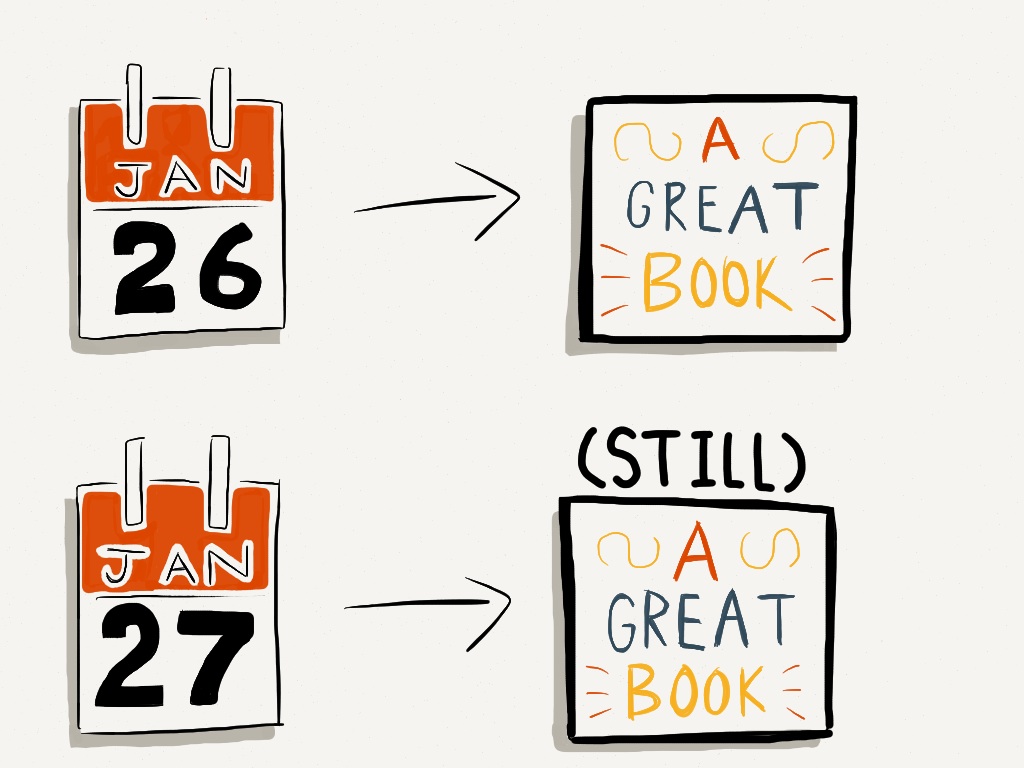
Meanwhile, the individual excellence of this year’s Caldecott winners according to the stated criteria is not in dispute. The individual excellence of the books that didn’t win is not in dispute — an assertion encapsulated by 2014 Caldecott committee member Travis Jonker in a cartoon drawn for Calling Caldecott: “Jan. 26 — a great book. Jan. 27 — (still) a great book.”
And the sheer number of spectacular picture books published in 2013 is cause for celebration. In 2010, a controversial article ran in The New York Times bemoaning the decline of the picture book; the 2013 crop of picture books may be the best rebuttal to that article’s claims. Is last year’s outpouring just a blip on the radar? Hopefully not. May 2014 bring an even greater embarassment of picture book riches. Authors, illustrators, and publishers — of all backgrounds and genders and passions and colors — bring it on.
Read editor Richard Jackson's profile of Brian Floca. For more, click on the tag ala 2014. From the July/August 2014 issue of The Horn Book Magazine.

Added To Cart
RELATED


RECOMMENDED
Please register with us to continue reading.
ALREADY A SUBSCRIBER? LOG IN
We are currently offering this content for free. Sign up now to activate your personal profile, where you can save articles for future viewing.
ALREADY A SUBSCRIBER? LOG IN
Thank you for visiting.
We’ve noticed you are using a private browser. To continue, please log in or create an account.

Add Comment :-
Comment Policy:
Comment should not be empty !!!
Sam Juliano
OK Jennifer Ward is mainly a writer. OK, I erred there.Posted : Jul 07, 2014 10:44
Sam Juliano
Just now saw and read this magnificent piece. I certainly do agree with it, especially the humility it exudes. The Caldecott Medal process is not remotely the edict of a privileged group, not is it to be confused with the naming of a pope with the guidance of a spiritual entity who is making sure the right decision is rendered. The Caldecott winners are solely the choices of a small appointed committee. They are neither right nor wrong. They represent a collective opinion. Just months after the Caldecott committee balked at naming MR. TIGER GOES WILD, the Boston-Horn Book promptly named it the best picture book of the year, seemingly as a rebuke to the ALA, whether intended or not. Do these contradictions mean that the Boston-Horn Book voters are less worthy or attuned than their ALA counterparts. Hardly. The results of the Boston-Horn Book awards are support for my arguments of months ago - arguments that admittedly got way out of control. I am a good part of the blame to be sure. But in year of so many picture book riches I take this comprehensive post to be further evidence that 2013 boasted incredible riches that called for more honor books. The books that are talked about here (NINO WRESTLES THE WORLD, ON A BEAM OF LIGHT, THE MIGHTY LALOUCHE and others are getting better with time.) And one final point that I did not bring out in that lamentable affair of yesteryear: David Weisner is a MASTER. No question whatsoever about this. he is one of the all-time greatest. No argument. And MR. WUFFLES is a fabulous book. Unquestionably. Love it! But six medals so far? Three Caldecott Medal and three Caldecott Honors? Six, while people like Wendell Minor, Yuyi Morales, Bob Staake, Jennifer Ward, Carin Berger, Jonathan Bean, and so many other great illustrators have yet to win a single citation in the main arena? The expected response from Caldecott committee members will be that they never at any time consider who has won what when considering the BOOK only. But it is impossible not to know the score when you are involved. MR. WUFFLES is a brilliant book, but NOT more brilliant than 6 or 8 others than were ignored, all of which roughly equaled it. As to LOCOMOTIVE, JOURNEY and FLORA AND THE FLAMINGO, I greatly enjoyed the writing here about each and consider all as picture book masterpieces. BTW, as to the possible reasons(s) why NINO may have been sidestepped, I'd say the attributes far outweigh any possible concerns. I am hoping the 2015 committee members will expand the boundaries so to speak. Personally in an art forms where there are potentially a hundred books worthy of recognition, less is never more. If anyone wishes to engage me I assure you I am a peace loving guy. :)Posted : Jul 07, 2014 10:37