


2018 School Spending Survey Report

The Horn Book website has lots of material of interest to teachers. Here are some areas to explore. And follow us on Twitter: #lollysclass
|
Interviews with authors and illustrators Recommended books -- reviews and themed book lists |
School -- reading in school, author visits, and more Suggestion box: what else to you want to see in Lolly's Classroom? |
Feathers | Class #4, 2015
Birds are great animals to study because they are found everywhere, not just in rural areas.
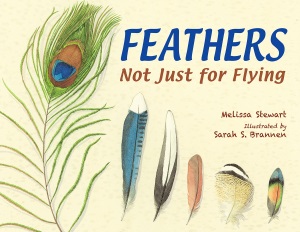 Birds are great animals to study because they are found everywhere, not just in rural areas. I love looking at books about birds around this time of year here in New England. The snow is starting to melt and — if you listen carefully early in the morning — you can hear new birds who have been silent or away for the past few months.
What do you make of the multiple ways Stewart delivers her information? Some people who prefer reading books from start to finish and are confused or frustrated by this piecemeal delivery of information. Others — particularly visual learners — like being able to browse around, reading the sidebars or captions to experience the book in bits and pieces.
This kind of multiple delivery is becoming more and more common in information books for children. And of course it's similar to navigating websites with menus and sidebars and hyperlinks. Notice how Brannen uses two different styles in her illustrations: a trompe l'oeil scrapbook style and a flatter, less photographic style for the pictures of each bird in action. What does this add to the experience.
I can't resist ending this post with a little off-topic plug for my own springtime obsession: nest cams. Cornell's Lab of Ornithology links to nests all over the US, and lots of teachers check in with their classes daily or weekly. Some of them have live chat options, too, with a knowledgeable moderator ready to ask questions and keep the conversation kid-friendly. My favorite is the great blue heron nest on Sapsucker Pond in upstate New York.


Added To Cart
RELATED


RECOMMENDED

Please register with us to continue reading.
ALREADY A SUBSCRIBER? LOG IN
We are currently offering this content for free. Sign up now to activate your personal profile, where you can save articles for future viewing.
ALREADY A SUBSCRIBER? LOG IN
Thank you for visiting.
We’ve noticed you are using a private browser. To continue, please log in or create an account.

Add Comment :-
Comment Policy:
Comment should not be empty !!!
Mary Winters
The first thing I noticed and enjoyed when reading this book was its layout. I really enjoy the scrapbook-like quality and the presentation and organization of information which was very engaging, it was also reminiscent (to me personally, I'm not sure if this was intentional) of a science textbook, which I thought was a great choice given the topic, and as a means to introduce children to different types of literature. I also learned a lot about feathers! Highlighting the different functions of feathers by comparing them to everyday objects humans use, really emphasizes the functional fixedness of feathers, which is perhaps a concept children may be able to apply to other objects after reading this book to increase critical thinking and deeper thinking/learning.Posted : Mar 25, 2015 06:22
Annie Thomas
I also really enjoyed that this was structured like a field notebook. I think children might find this relatable and perhaps want to create their own! The author compares the functions of the feathers to things a child might be familiar with, which makes this book even more engaging. I like that the illustrations are in different mediums, this helped with my engagement and so I think children might find this interesting as well.Posted : Mar 25, 2015 02:43
Rebecca Tan
I really enjoyed learning about the different functions of feathers. I felt that the author made learning about feathers (and also birds) really engaging and easy firstly by having a different font for the titles or topic sentences of each page. These help readers clearly read what are the functions they will learn about. In addition, the illustrations and additional information are drawn as if they were put together in a scrapbook. Overall, the book appears to be a bird watcher's field notebook, which keeps the young readers engaged and makes the information appear more authentic and true. I feel like this book has a lot of information and might need to be read in parts. However, it could encourage readers to start a scrapbook of information of their own. I think that would be one exciting project that could come of this.Posted : Mar 25, 2015 12:15
Joshua Jenkins
I'm so glad the topic of this post is about the multiple delivery! As I read the book, I kept thinking, "This book has to be read and reread." If you want to get just the "narrative" portion of the story (the big, black print), you can read it straight through as stopping at the sidebars interrupts the flow. However, the sidebars are lovely points learn the actual "information" of the informational text. I think I'm still figuring out how this book would work as a read aloud in a class or if it should be. I also think the illustrations of this book fit the mood--pictures and sidebars are "taped" to the pages, just like the idea board of someone who bird watches or researches wildlife would do.Posted : Mar 24, 2015 05:31
Sara Gordon
I loved this book, mainly because I found the watercolor illustrations absolutely gorgeous. In addition to the beautiful illustrations, I found the text very effective; at the top of each page, the sentences ("Feathers can X or Y") are very brief and rhythmic, so that text is great for young children who are just learning to read. The text on each page written below is more descriptive, and definitely adds to the reader's understanding of the function(s) of the feathers and what the bird does. However, it is not required for a young child to get the gist of the book, and an adult can always step in to read these parts to the child as well. I also appreciated the use of similes on every page ("Feathers can shade out sun like an umbrella," "Cushion like a pillow"), which also allow readers (of all ages!) to envision the bird and its feathers.Posted : Mar 24, 2015 02:31