



2018 School Spending Survey Report
Fostering Wonder
Sixty years ago, Rachel Carson first opened our eyes to children’s need for a sense of wonder about the natural world in her essay “Help Your Child to Wonder” (first published in Woman’s Home Companion in 1956).
Certainly, careful crafting of text and pictures is a must. Thoughtful choices and arrangement of words and images, an engaging narrative, attention to the magic of the page turn — all the ingredients of any successful picture book are just as necessary in an outstanding book about the natural world. But there are a few more specific criteria.
 Stories should highlight the child’s connection to the natural world.
Mary McKenna Siddals and Patrice Barton’s Bringing the Outside In shows a diverse group of exuberant children at play throughout the seasons, bringing their discoveries — and their mess — inside. Lauren Stringer’s Yellow Time captures the anticipation of neighborhood children as they await the moment each fall when the wind blows the leaves off their trees, turning the very air yellow. In Goodbye Summer, Hello Autumn Kenard Pak imagines a conversation between a young girl and the natural world around her: on a walk to town and back, she greets everything she sees and senses (trees, birds, thunder, a chilly breeze) and hears from them about the ongoing seasonal changes.
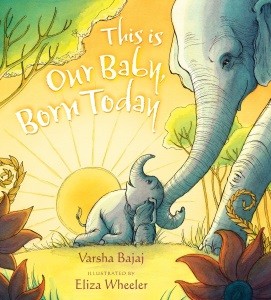 Successful books connect animal behavior with human behavior, where appropriate…
without making the animals miniature human beings. An elephant family, its herd, and the world around them celebrate the birth of a baby Indian elephant, “wrinkled and gray,” in This Is Our Baby, Born Today, written by Varsha Bajaj and illustrated by Eliza Wheeler. Although the emotions are humanlike, they are shown through behaviors appropriate to the species, including relatives circling the newborn, the herd trumpeting, cousins showering it with mud, and so forth. Listen to Our World, an older text by Bill Martin Jr and Michael Sampson, newly and imaginatively illustrated by Melissa Sweet, shows mothers around the world encouraging children to enjoy the sounds animals make. Both lap-sitters and storytime-listeners will feel the connection, wanting to chime in with the sounds woven into the illustrations.
 Organization matters.
Stories are often presented chronologically, structured as a series of events over the course of a day or over a year (frequently divided into the seasons of the northeast and north central states, with winter including snow). Ella Bailey’s One Day on Our Blue Planet…in the Antarctic follows a young Adélie penguin, from her last springtime breakfast with her parents, through summer feeding in the ocean, winter resting on the ice, and sunrise again in the spring. The gentle story (and helpful endpapers) introduces readers and listeners to an unfamiliar ecosystem through predictable seasonal events and milestones.
 In the Australian import Platypus, author Sue Whiting uses a common device in nature-themed nonfiction picture books — a two-level text — with a main narrative and a separate section of additional facts on the same spread. This is often in a different, smaller font, and aimed at older readers or listeners who would like to know more. Whiting’s main story chronicles a male platypus’s nighttime activities; the extra facts provide details about the physiology, habits, diet, and feeding of this unique nocturnal mammal.
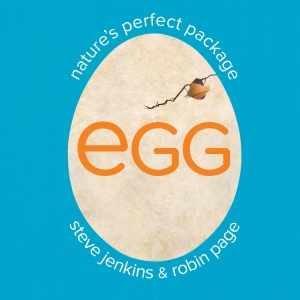 Together, Steve Jenkins and Robin Page have been collecting intriguing facts about animals and organizing them in surprising ways for over fifteen years. A recent title is Egg: Nature’s Perfect Package, in which they demonstrate, through numerous examples, how almost every animal begins life as an egg. The clean design sets text and images on a plain white background. And of course Jenkins’s trademark cut- and torn-paper images highlight the most salient details of each animal and each egg. The back matter gives readers more information, and thumbnail images serve as a sort of index. Appealing, accessible, and accurate — this is exactly what’s needed in successful nonfiction.
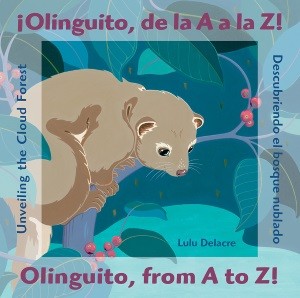 For the very young, numerical and alphabetical order are common frameworks. In Lulu Delacre’s bilingual introduction to the Ecuadorean cloud forest and its inhabitants, ¡Olinguito, de la A a la Z! / Olinguito, from A to Z!: Descubriendo el bosque nublado / Unveiling the Cloud Forest, the Spanish text is given first and the entries are alphabetized by their Spanish names — as they would be in Ecuador, home of this newly discovered mammal.
Careful crafting of language is important.
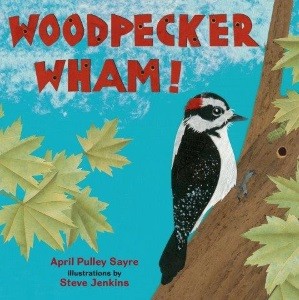 The rhythm, rhyme, and repetition of sounds in poetry can increase the pleasure of reading aloud and listening, enhancing the positive connection to the subject. Rhyming couplets are a familiar form, but few writers handle them as effectively in nature books as does April Pulley Sayre, whose Woodpecker Wham! introduces various woodpecker species, showing their habits and habitats while loosely following the story of building a nest and raising young. Short verses and repeating sounds invite listener participation, while Steve Jenkins’s illustrations show well to a group. With cut and torn papers, he produces clean, stylized images that are easily recognizable.
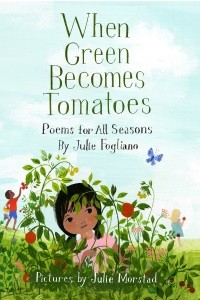 In When Green Becomes Tomatoes: Poems for All Seasons, Julie Fogliano creates journal entries that are a series of short free-verse poems celebrating the changing seasons. With perceptive observations and vivid imagery, the poems reflect the writer’s own sense of wonder and her appreciation of many aspects of the natural world. Julie Morstad’s delicate, colorful illustrations — from spot-art decorations to double-page spreads — show children of varying skin tones watching, waiting, playing, thinking, and appreciating the outdoors.
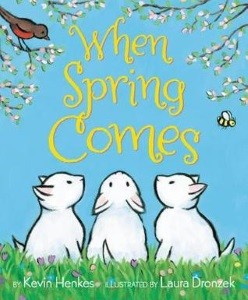 For young children (and many of the rest of us), illustrations are key to understanding, so it’s vital to look at how a story is pictured as well as how it’s told. “Wonder” doesn’t have to be synonymous with “excitement.” Kevin Henkes’s When Spring Comes, illustrated by Laura Dronzek, for example, is another demonstration of the magic of the change of seasons. Dronzek’s vibrant paintings show the change in color from the blue-gray of winter to the pinks and yellows of spring. A snowman melts. A seed grows. A bird hatches. Children and kittens watch and wonder and bounce across pages.
In the best nature books, the illustrations may even convey more about the setting than the text does. When animals are shown in their usual habitats, the viewer has a richer experience. And illustrators can vary the perspectives they use. They can bring a child much closer to the subject than he or she is likely to get in real life or they can back off to show the surroundings, even offer a bird’s-eye view. Mark Jackson’s mixed-media paintings for Platypus range from a clear full-face portrait, showing the animal’s characteristic duck-bill and claws, to a distant scene showing the whole platypus hiding in the water from a foxlike predator. They also suggest how difficult it might be to see a platypus in the wild.
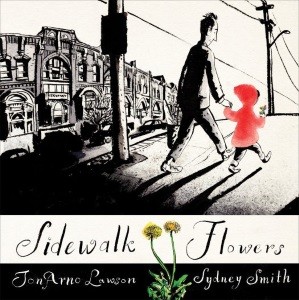 A child’s appreciation for the natural world can be shown even in a wordless, totally imagined — and city-set — story like that of the young girl in JonArno Lawson and Sydney Smith’s Sidewalk Flowers. As she shares the flowers she’s found, her gray urban surroundings become increasingly colorful for us all.
Children’s book illustrations may be painted, drawn, carved, etched and printed, scratched, pasted, and/or digitally generated or enhanced. They also may be photographs. Styles vary from realistic to quite abstract. Rick Lieder’s dreamlike photographs, with their close-up portraits and soft backgrounds, illustrate Helen Frost’s poem, Among a Thousand Fireflies, chronicling the effort of a single firefly to find her mate. In contrast, Sylvia Long’s watercolors illustrate the long-running series she’s done with writer Dianna Hutts Aston (recent examples are A Nest Is Noisy and A Beetle Is Shy) with striking detail. The wonder here is the astonishing variety in the natural world. Each mammal or bird, egg, nest, and beetle is meticulously drawn and colored and identified in hand-lettering on the page.
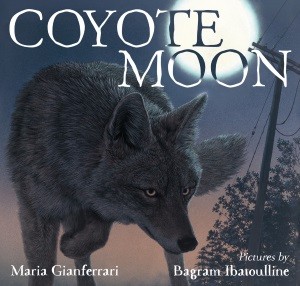 In distinguished picture-book illustration, chosen media, colors, and design support the text and are age-appropriate. Illustrators make careful choices about what they will show and how they will show it. For example, and presumably in deference to sensitive children, illustrator Bagram Ibatoulline shows neither the actual kill nor the eating in Coyote Moon, Maria Gianferrari’s account of a coyote prowling through a suburban neighborhood at night to find food for her family. Instead, the final spread shows her pups sleeping contentedly, “full-bellied” after their wild turkey meal. The vibrant collage images in Delacre’s ¡Olinguito! include real pressed flowers and leaves. Illustrators often add an additional dimension to the text. Miranda Paul’s explanation of the water cycle, Water Is Water, is enhanced by Jason Chin’s paintings of a diverse group of children playing outside throughout the year. We get not just information about the water cycle but characters to follow as the year goes on. The children’s enthusiasm certainly seems to model what Carson and, later, Louv had in mind.
* * *
 Since the publication of Carson’s essay in 1956, there has been increasing mainstream concern about the environment. This has filtered down from adults to children who learn about environmental issues in well-meant books that sometimes stress the losses more than the wonder that can still be found in nature. Environmental educators worry about a phenomenon called “ecophobia,” in which people distance themselves from the depressing news, turning away from the very things a writer hopes readers will want to work to save. In presenting environmental bad news to people of any age, these educators suggest framing problems carefully, starting with shared values (that is, the positive) and spotlighting community-level solutions. The suggestions for “going green” that are appended to numerous books about the natural world may help children become responsible environmental citizens, but they’re not enough to solve the larger problems. Modeling positive community action, though, can give children — and their caregivers — some hope. Jim LaMarche’s Pond lovingly describes a remembered childhood experience of bringing a trash-filled area back to life through cleaning and reviving a pond in the woods. In Philippe Cousteau and Deborah Hopkinson’s Follow the Moon Home: A Tale of One Idea, Twenty Kids, and a Hundred Sea Turtles, primary-school-aged students can learn how older students banded together in a successful community action to save the nests of endangered sea turtles. Meilo So’s paintings convey the appeal of the hatchlings and the magic of moonlit nights.
The best “sense of wonder” books reveal the creators’ own curiosity, admiration, and enthusiasm for the endless variety and complexity of the natural world. Shared with young readers, they can help inspire a new generation to develop the same feelings.
From the January/February 2017 issue of The Horn Book Magazine.

Added To Cart
RELATED


RECOMMENDED

Please register with us to continue reading.
ALREADY A SUBSCRIBER? LOG IN
We are currently offering this content for free. Sign up now to activate your personal profile, where you can save articles for future viewing.
ALREADY A SUBSCRIBER? LOG IN
Thank you for visiting.
We’ve noticed you are using a private browser. To continue, please log in or create an account.

Add Comment :-
Be the first reader to comment.
Comment Policy:
Comment should not be empty !!!