


2018 School Spending Survey Report

The Horn Book website has lots of material of interest to teachers. Here are some areas to explore. And follow us on Twitter: #lollysclass
|
Interviews with authors and illustrators Recommended books -- reviews and themed book lists |
School -- reading in school, author visits, and more Suggestion box: what else to you want to see in Lolly's Classroom? |
Glass Slipper, Gold Sandal | Class #5, 2016
One of the fascinating and mysterious things about folklore is that the same story types appear all over the world.
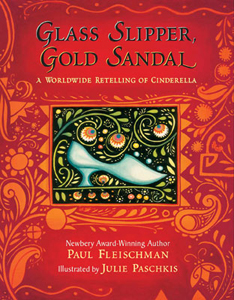 One of the fascinating and mysterious things about folklore is that the same story types appear all over the world. Here's a single picture book that tells a Cinderella-type story as found in several different cultures.
I think children would need to first be familiar with a single, cohesive version of this story in order to appreciate this book, but that is easily done. There are plenty of terrific stand-alone picture books of Cinderella, Cendrillon, etc., including our old friend John Steptoe's Mufaro's Beautiful Daughters.
What do you make of this one? Notice how the story is made cohesive, yet also kept separate, thanks mostly to Paschkis's illustrations and the book's design. Does this work for you? For children?


Added To Cart
RELATED


RECOMMENDED

Please register with us to continue reading.
ALREADY A SUBSCRIBER? LOG IN
We are currently offering this content for free. Sign up now to activate your personal profile, where you can save articles for future viewing.
ALREADY A SUBSCRIBER? LOG IN
Thank you for visiting.
We’ve noticed you are using a private browser. To continue, please log in or create an account.

Add Comment :-
Comment Policy:
Comment should not be empty !!!
Ken Hagberg
Sorry guys, I’m late to the party this week, but I must say I absolutely loved this book! Definitely my favorite for the semester. This was definitely one of those books in which the cover alone would lured me in and by the time I opened it to see the map of all the different places in the story I was hooked. The background illustrations were all similar enough in style to connect the points, but different enough in color to also keep them separate. I thought it was a great balance. I’m excited that Caroline and Tom have already used this book for interventions and look forward to do the same.Posted : Apr 28, 2016 08:07
Tom Grasso
I agree with so many of the comments already posted. Like Caroline, I, too, used the book with a student whom I worked with in a one-on-one intervention. Because she was a fourth grader, this particular student had a lot of background knowledge about the Cinderella folk tale, so it was easy for her to access. And similar to Caroline's student, my student was particularly interested in comparing and contrasting the details of this book with the "traditional" Cinderella she already knew. As others have posted, it might be harder for younger children to to access the book as a cohesive story without the right amount of introduction. But I worry that if TOO MUCH background information is given to younger students to "prepare" them for this Cinderella-like tale, the magic of Fleischman's text and Paschki's illustrations might be lost; they need to be appreciated in and of themselves. What I particularly liked was the author's note at the beginning of the story, highlighting the history of the Cinderella tale and underscoring the point that we are all connected in this world even through the stories we tell. The end of the book also highlighted this interconnectedness by bringing together many of the different cultures and traditions in the final wedding scene which was so grand "that people today are still telling the story."Posted : Apr 27, 2016 02:00
Erin King
I agree with what most other people have said so far on this thread. I have only read one other version of Cinderella that is different from the original version, and I learned a lot from this culmination of various versions from different cultures. I found the countries' labels to be helpful, and I think this book could be a great component in a unit plan comparing aspects of different cultures. I was also captivated by the illustrations; the colors were eye catching and the designs were intricate.Posted : Apr 27, 2016 01:41
Madeline Loughridge
I definitely agree with all that has been said here. There is a big focus on writing fairytales in first grade, so I'm excited to integrate this story! Students have the opportunity to compare different fairytales and also different versions of the same tale. It will be interesting to hear the different things students can pull from this story that travels around the world.Posted : Apr 26, 2016 08:16
Iliana Gutierrez
I agree that Fleischman did a very good job of creating a cohesive narrative of Cinderella tales from different regions. One of the things that must have been tricky for the illustrator to consider was how she could create an element of cohesiveness through her illustrations while still reflecting the varying details from particular regions. Even though the Cinderella character looks different from region to region, she helps to create that cohesive element. Like Carla described above, the style is broad enough to encompass all the different cultures, but is still distinct enough to portray the differences. I was especially struck by how much additional information could be gathered from the background illustrations. The details infuse the narrative with depth.Posted : Apr 26, 2016 07:52