


2018 School Spending Survey Report

The Horn Book website has lots of material of interest to teachers. Here are some areas to explore. And follow us on Twitter: #lollysclass
|
Interviews with authors and illustrators Recommended books -- reviews and themed book lists |
School -- reading in school, author visits, and more Suggestion box: what else to you want to see in Lolly's Classroom? |
Information books | Class #4, 2016
Our next class will be in two weeks, on April 21.
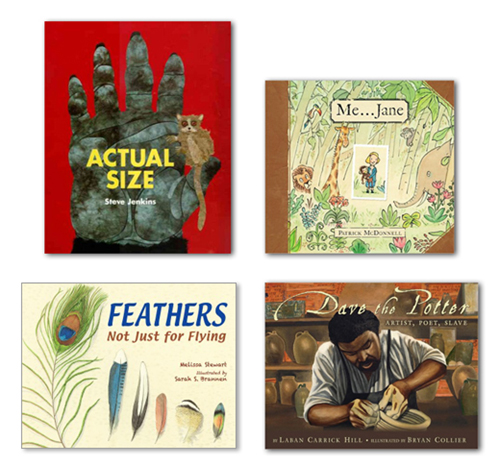
Our next class will be in two weeks, on April 21. We'll be talking about four information books:
- Actual Size by Steve Jenkins
- Me…Jane by Patrick McDonnell
- Feathers: Not Just for Flying by Melissa Stewart, illustrated by Sarah S. Brannen
- Dave the Potter by Laban Carrick Hill, illustrated by Bryan Collier
Things sure have changed since I was in elementary school. Instead of providing every fact known — or at least everything needed to write a report — information books nowadays aim to be as engaging as possible in order to get children interested in their subject. The idea is that it's better to leave them wanting more and then provide a bibliography at the end of the book. I think this is a big improvement.
The other new development is that these books provide information on several levels, often using different typefaces and type sizes for each. Every year, some of my ed students are frustrated by this kind of delivery, finding it draining or overwhelming, and they fear their students will dislike it, too. Others, particularly visual learners and those who know kids with attention issues, love it. I think the key is to let children explore these books rather making them "accountable for" reading and retaining every word. If the subject engages a child, then he or she might go through the book a second, third, and even fourth time, reading and noticing more and more.
Please join us in discussing these books at the links above. We're also reading three articles related to Dave the Potter's Coretta Scott King award. You can find the articles at the links below, but we'll discuss them here.

Added To Cart
RELATED


RECOMMENDED
Please register with us to continue reading.
ALREADY A SUBSCRIBER? LOG IN
We are currently offering this content for free. Sign up now to activate your personal profile, where you can save articles for future viewing.
ALREADY A SUBSCRIBER? LOG IN
Thank you for visiting.
We’ve noticed you are using a private browser. To continue, please log in or create an account.

Add Comment :-
Comment Policy:
Comment should not be empty !!!
Carla Cevallos
In my Adolescent Literature at HGSE, I discovered non-fiction books and fell in love with them. I think I had never read a YA non-fiction book! As a teenager, my readings were basically divided in fiction and text books. Text books... are boring. Discovering the world of non-fiction (good, engaging non-fiction) was fascinating! What a great way for young people to learn about a topic! Illustrations, photographs, embedding facts in a story line, presenting evidence in pieces... all great opportunities to combine literature with pure knowledge! Now, information books for children left me with the same feeling. I discovered that there were tons of things I didn't know about feathers, and I really enjoyed learning about them (while if I had been asked to read about feathers in a text book I would probably have not been very happy). I enjoyed letting my imagination dive into Dave Potter's workshop, and playing with my hands to mimic the animals' sizes in Actual Size. I think many schools sadly waste the opportunity to teach facts and information through great works of literature, and are falling into a big mistake by equating literature with fiction and information with text books.Posted : Apr 19, 2016 08:31