


2018 School Spending Survey Report

The Horn Book website has lots of material of interest to teachers. Here are some areas to explore. And follow us on Twitter: #lollysclass
|
Interviews with authors and illustrators Recommended books -- reviews and themed book lists |
School -- reading in school, author visits, and more Suggestion box: what else to you want to see in Lolly's Classroom? |
How I Live Now
At the outset of Meg Rosoff’s How I Live Now, Daisy and her cousins in the English countryside are blissfully removed from the threat of impending war.
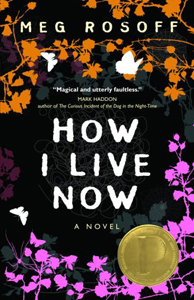 At the outset of Meg Rosoff’s How I Live Now, Daisy and her cousins in the English countryside are blissfully removed from the threat of impending war. In some ways, the insular, adult-less world of the young people might exist in any time and place, yet their world is irrevocably changed as the story progresses. Are there other stories, set in times of war, or not, that Rosoff’s novel invokes for you? Which characters, scenes, or ideas from the novel linger with you after reading?
You can also comment here on the article we're reading this week: Interview wth Meg Rosoff in The Sunday Times.


Added To Cart
RELATED


RECOMMENDED

Please register with us to continue reading.
ALREADY A SUBSCRIBER? LOG IN
We are currently offering this content for free. Sign up now to activate your personal profile, where you can save articles for future viewing.
ALREADY A SUBSCRIBER? LOG IN
Thank you for visiting.
We’ve noticed you are using a private browser. To continue, please log in or create an account.

Add Comment :-
Comment Policy:
Comment should not be empty !!!
Amy Lipton
I wanted to echo Rachel's thoughts on how honestly this novel displays the experience of young children and teenagers living in war-stricken times. Perhaps the most powerful line in this novel was when Daisy commented, "No matter how much you put on a sad expression and talked about how awful it was that all those people were killed...the fact that none of us kids said out loud was that WE DIDN’T REALLY CARE." I was taken aback when I first read that sentence. Moments later, I realized (with a little bit of horror) that the reason I was so impacted by this sentence was because of the ease with which I related to the sentiment that Daisy was expressing. On another note, something that stuck with me for the duration of the book was that "the enemy" was never identified. At first, the absence of this detail simply bothered me. However as the story progressed, I realized that by not naming the enemy, Rosoff effectively emphasized how pervasive war and terrorism are in today's world.Posted : Oct 20, 2014 02:34
Travis
Daisy's perceptions of certain things close to her character change in various ways based on the stimulus that affects them. For example, before coming to England her use of under eating, while it may have started as a concept that her father's girlfriend would poison her, probably continued as a way to exercise some control over a situation where she lacked it. She could make her father worry about her and therefore pay her some attention that she felt was missing due to his new relationship. In beginning to love Edmond, she feels the hunger of being in love, which is taking the hunger that she was in control of and changing it to something out of her control, despite the fact that in its new form it was a more positive force than by using it to be underweight. Then, when Daisy and Piper are traveling from the McEvoy house, Daisy notices that Piper has gotten thin. While at one time she would've seen this as something good, now she can see the reality of the situation, which is simply that it's not beneficial for children to lack food, especially ones still developing in childhood. As they eat mushrooms she realizes that she was starving herself foolishly, and hopes that Piper never need undergo something where some form of self-harm is your only feeling of control in a situation.Posted : Oct 19, 2014 09:19
Sophie Barnes
The war is abstract throughout the entire novel and while it is crucial to the plot, it feels almost tangential. No matter what happens to the children and how much the war influences their life directly and indirectly, they still do not feel like it touches them. Interestingly, no matter what happens, we are still in one world, the world inside Daisy’s head and as it exists through her eyes. I liked that the reader saw the world solely from Daisy’s point of view, this unique perspective protected the reader from the harsher realities of the outside world. I felt buffered from the effects of the war, almost as if I were drifting beside Daisy in an Alice in Wonderland dreamlike state. I wonder if her own thoughts, thought processes, and “fantasy world,” such as Isaac's and Edmond’s telepathic gifts, protected her from her own struggles and the outside world. The only divergence from this separate world occurs when Piper talks about missing her mother. At these times, I was reminded of the realities of the war and its direct effects on individuals. Lastly, I was intrigued by Elizabeth’s nickname of “Daisy.” Daisies are beautiful flowers, but they are also durable, which perhaps foreshadows Daisy’s ability to survive dire circumstances. Growth was also a key part of the novel for sustenance, such as when they are living with the general or back on the farm in England, and as a proxy for many of the emotions of individuals in the novel. Growth did not necessarily mean moving forward. While in the beginning of the novel the garden was filled with 100,000 white roses, by the end it was frightening and full of rage. The concept of growth, in every sense of the word, played an interesting role in the novel.Posted : Oct 19, 2014 08:28
Rachel Lacks
I thought How I Live Now was a refreshingly realistic portrayal of young children living through a period of war. As much as everyone tries to directly feel everything going on in the war, when it does not pertain to oneself, it is often hard to generate such strong feelings of empathy and connection to the lives being lost, even though others may look down upon this selfish perception. As Meg Rosoff mentioned in her interview, the way that Daisy mentioned that "seven or 70,000 people died" so far in the war may seem controversial and ignorant of the lives being lost. I found this to be quite accurate, however, in terms of how young children feel about a war that they themselves are not experiencing directly yet. I agreed with and wanted to touch upon Warren's point about Edmund and Daisy being cousins. I did not quite understand the relevance of this point in the plot either, just because the incestuous aspect was not really touched upon. I was not sure what it added to the relationship, because I did not feel that Daisy and Edmund formed a bond because of the fact that they felt close as cousins; it was more the idea of feeling a connection to someone new in a time of distress. I was wondering why this point was not more thoroughly addressed, or what the thought behind it was.Posted : Oct 19, 2014 08:09
Nancy Fan
Though based at a time of a future world war, in some ways How I Live Now also feels like it is set in World War II. The mixture of a past and future alternate universe reminded me of Maggot Moon, by Sally Gardner, which also has a mix of survival and tenderness. I agree with Warren on the initial petulance of Daisy's voice; her flat hate for her stepmother and her attitude toward her eating disorder do not make her that readily relatable. However, the contrastive effect as Daisy is thrown into new dangers and grows, redeems her. While I feel the incestuous relationship between Daisy and Edmond was a situation intended to generate controversy, when it is considered alongside the presence of the magic of telepathic powers and madness of wartime brutality, it is not particularly shocking and fits right in.Posted : Oct 19, 2014 07:42