


2018 School Spending Survey Report

The Horn Book website has lots of material of interest to teachers. Here are some areas to explore. And follow us on Twitter: #lollysclass
|
Interviews with authors and illustrators Recommended books -- reviews and themed book lists |
School -- reading in school, author visits, and more Suggestion box: what else to you want to see in Lolly's Classroom? |
Mrs. Chicken and the Hungry Crocodile | Class #5, 2016
There are so many stand-alone folktale picture books that it's hard to choose just one for us to read together.
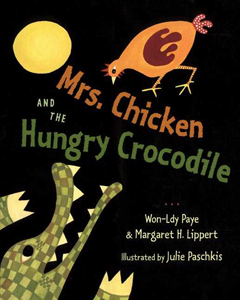 There are so many stand-alone folktale picture books that it's hard to choose just one for us to read together. But I've used this one for several years because of its humor, voice, and authenticity. Interestingly, it also represents two story types: noodleheads (heroes or heroins who are a bit scatterbrained) and tricksters (a small person or animal who is lower in a hierarchy — like the food chain — tricking the higher-up character).
I urge you not to try too hard to find a message for children here. Lots of folktales are meant for pure enjoyment and escapism. One reason kids like trickster tales is because they can identify with the lower class or smaller characters, since most of the time in their world, the adult calls the shots — and wins the arguments.


Added To Cart
RELATED


RECOMMENDED

Please register with us to continue reading.
ALREADY A SUBSCRIBER? LOG IN
We are currently offering this content for free. Sign up now to activate your personal profile, where you can save articles for future viewing.
ALREADY A SUBSCRIBER? LOG IN
Thank you for visiting.
We’ve noticed you are using a private browser. To continue, please log in or create an account.

Add Comment :-
Comment Policy:
Comment should not be empty !!!
Sarah Cole
This story was so entertaining! In the beginning of the story the chicken does come across as a bit of a noodle head, due to her obsession with viewing her own wings and this mistaking a crocodile for her own reflection. But then by the end of the story she seems really quite clever! I think the genre itself allows some of this flexibility- it worked so well together to provide a funny tale!Posted : Apr 27, 2016 05:27
Jason Brown
I was most captivated by the pictures of this story. To add to what Heewon said, there is a stark contrast between the crocodile and the chicken, aside from just their personalities. The crocodile is styled in a green color, whereas the antagonist character is in the opposite color, orange. I also felt the many geometric shapes the illustrator used were pleasing to the eye and urged me to keep reading. Aside from the pictures, I thought the storyline was captivating. I actually felt nervous for the chicken at the beginning when she was in the water near the crocodile. I think when the reader expresses emotions and feels sympathy for the characters, the author did a fine job with the storyline!Posted : Apr 27, 2016 03:32
Kaitlin Herbert
I agree with what Kate said- a lot of fables certainly seem very preachy and the lesson is often very obvious. I enjoyed this fable, especially the cunning abilities of the chicken (which is often a reversed role in typical fables), and the hidden lesson: not to take what you have for granted (puddle vs. river). I also really enjoyed the illustrations in this text as they were bright and used beautiful geometric patterns to illustrate differing textures.Posted : Apr 27, 2016 02:14
Annie Kleiman
This was such a clever story, especially the switching of the babies. I was especially amused by how convincing Mrs. Chicken was; I almost felt sorry for the crocodile because she was so excited to have a sister!Posted : Apr 27, 2016 01:53
Kate Cunningham
Some folktales and fables can sound sort of preachy and predictable, almost talking down to kids, but this Mrs. Chicken and the Hungry Crocodile was a delight to read, and told so skillfully by Paye and Lippert. It took me a while to get away from the notion that this tale had to have a lesson, but once I did it seemed to me that both Chicken and Crocodile act as tricksters in different parts of this tale, and both had flaws that made them fall for the others' tricks. This is a little different than Lolly's description above but I think kids would love the double trickster takeaway too, as children (especially siblings) often play tricks on each other back and forth. I thought the illustrations fit perfectly with the story, reflecting both folk art and the folktale's Liberian heritage. I also personally loved that both characters in this folktale were female - something I've found rather rare in protagonists of folktales and fables.Posted : Apr 27, 2016 01:42