


2018 School Spending Survey Report

The Horn Book website has lots of material of interest to teachers. Here are some areas to explore. And follow us on Twitter: #lollysclass
|
Interviews with authors and illustrators Recommended books -- reviews and themed book lists |
School -- reading in school, author visits, and more Suggestion box: what else to you want to see in Lolly's Classroom? |
Mrs. Chicken and the Hungry Crocodile
There are so many stand-alone folktale picture books that it's always hard to choose just one for us to read together.
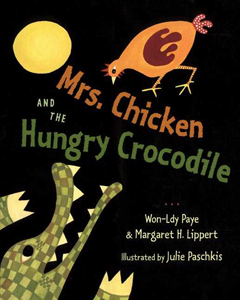 There are so many stand-alone folktale picture books that it's always hard to choose just one for us to read together. But I like this one for its humor, voice, and authenticity. Interestingly, it also represents two story types: noodleheads (heroes or heroins who are a bit scatterbrained) and tricksters (a small person or animal who is lower in a hierarchy -- like the food chain -- tricking the higher-up character).
I urge you not to try too hard to find a message for children here. Lots of folktales are meant for pure enjoyment and escapism. One reason kids like trickster tales is because they can identify with the lower class or smaller characters, since most of the time in their world, the adult calls the shots -- and wins the arguments.


Added To Cart
RELATED


RECOMMENDED

Please register with us to continue reading.
ALREADY A SUBSCRIBER? LOG IN
We are currently offering this content for free. Sign up now to activate your personal profile, where you can save articles for future viewing.
ALREADY A SUBSCRIBER? LOG IN
Thank you for visiting.
We’ve noticed you are using a private browser. To continue, please log in or create an account.

Add Comment :-
Comment Policy:
Comment should not be empty !!!
E. Ucan
I enjoyed the unlikely pairing of a chicken and a crocodile and how, despite the initial adversity between the two, they were able to bond in the end of the story. I appreciate that the author points to similarities in these two characters. I like the narrative that you can find a friend in the most abnormal, even threatening, scenarios. The female characters bonding in the end over the birth of their children was a lovely way to end the story. It reinforces the author's belief (so perceived) need for women to support each other. The playful artwork complimented this meaningful underlying statement.Posted : Apr 02, 2014 08:34
Esther (Kyungeun) Lee
I loved the color scheme of this book. The details of all the images, especially the two main characters, were unique and intriguing. My favorite illustration was the one in which Mrs. Chicken tries to see her reflection in the pond and finds the hungry crocodile instead. In very subtle ways, they do look like reflections of each other (must be the way their bodies are angled). Which hints at the ending in which Mrs. Chicken convinces the crocodile that they are, indeed, from the same family. I enjoy stories like these when an "underdog" outwits its "opponent."Posted : Apr 02, 2014 07:24
Lindsey Horowitz
A lot of the posts above have commented on Mrs. Chicken's characterization, but I think that the crocodile's characterization was also unique. Not only did the crocodile outwit Mrs. Chicken in the river scene, but she also sacrificed her own food in order to make Mrs. Chicken more plump. Because of this, I would say that she is quite a dedicated character, and not an unreasonable one, either. This unusual characterization relates to what Danya and Sarah mentioned about gender roles, and how neither character measures up to expectations in the usual fashion - they exceed them.Posted : Apr 02, 2014 05:46
Dayna Lellis
I think this book would be great to read to children because it is not one of the "typical" folktales that many children encounter since it is a retelling of a Liberian story. Like Sarah T., I also found it interesting that both of the characters were female (although necessary for Mrs. Chicken's plan). By having characters of the same gender portray such different traits, it challenges some of the traditional gender roles that readers might expect when it comes to personality and power. The illustrations were visually appealing and one must admire Mrs. Chicken's ingenious plan to escape death.Posted : Apr 02, 2014 12:34
Sarah Thompson
I agree with Jennifer that the lesson is one of quick-witted self-preservation! And perhaps a bit about the power of relatedness in the world. I found it interesting that the crocodile character was female--is this an unusual choice? I suppose I'm just used to the paradigm of the evil male character and the (seemingly) weak and vain female character--apparently I could have used some exposure to tales like this one as a child!Posted : Apr 01, 2014 11:31