


2018 School Spending Survey Report
Tasty traditions
Pass the soy sauce or the tea saucer…and try a taste of these six picture books about food traditions passed from one generation to another.
Pass the soy sauce or the tea saucer…and try a taste of these six picture books about food traditions passed from one generation to another. For a timely early reader where food similarly figures in to love of one’s heritage, check out Ling & Ting's Lunar New Year: Two Times Lucky by Grace Lin. See also our list “A buffet of books” from the June 2024 Notes issue and our Five Questions interview with Hyewon Yum about A Spoonful of the Sea in this issue of Notes.
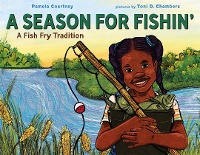 A Season for Fishin’: A Fish Fry Tradition
by Pamela Courtney; illus. by Toni D. Chambers
Primary Farrar 40 pp.
5/25 9780374390907 $18.99
e-book ed. 9780374395360 $10.99
It’s “Fish Fry Friday,” and Cher can’t wait: she is finally able to go on the family fishing trip. Papere gives her Great-Pere’s pole, with which he “won beaucoup contests,” and she joins her uncles around Cane River. The uncles “trash talk” and the children giggle. Cher finds a spot and quietly waits for the bream to bite. She catches a bucketful, but in her excitement gets tangled in her rod and loses all her fish. Though Cher is disappointed, Mamere gives her a red apron so she can help prepare the meal and reminds her granddaughter that the day is about family, not the catch. Courtney’s debut picture book celebrates the fish-fry tradition from her childhood in Louisiana. Chambers’s digital illustrations add to the celebration, with scenes of the fish fry exuding joy as people dance, eat, and play music. The endpapers show a table filled with fried fish, corn, and Cajun spice. This offering is a welcome addition to the growing landscape of picture books by Black authors highlighting the diversity of Black American life. An author’s note and a dictionary with words of French origin from “my rural, Southern English” are appended. NICHOLL DENICE MONTGOMERY
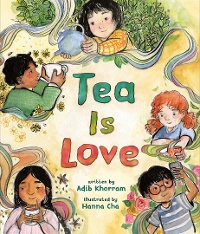 Tea Is Love
by Adib Khorram; illus. by Hanna Cha
Primary Dial 40 pp.
10/25 9780593618530 $18.99
Tea begins as a plant, plucked from misty hillsides. It is transported to a teahouse, purchased, and then steeped and shared. From there, it appears in many forms: poured at a wedding, brewed for tired new parents, sipped on a quiet morning, shared with a neighbor. Khorram’s spare, rhythmic text strings together such brief declarations as “Tea is a plant,” “Tea is a ceremony,” and “Tea is a memory,” with frequent interjections of the refrain “And tea is love.” The effect is meditative and expansive, showing tea not only as a drink but also as a vessel of history, tradition, and connection. Cha’s watercolor illustrations expand on each phrase, turning words into full scenes that convey both intimacy and community. Swirls of steam drift across the spreads, linking vignette to vignette and making the book feel fluid and continuous. These visual transitions give the minimal text added resonance, so the story unfolds not as a straight line but rather as a tapestry of experiences. The book’s simplicity invites young readers to consider its themes of tradition, memory, and care. An author’s note places tea in its global and historical context. Together, words and pictures create a work as warming and sustaining as the drink itself. WEILEEN WANG
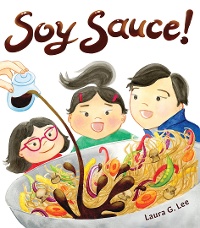 Soy Sauce!
by Laura G. Lee; illus. by the author
Primary Algonquin 40 pp.
1/25 9781523528387 $18.99
Pungent, salty, silky soy sauce takes center stage in this playful picture book honoring the centuries-old condiment and the time and care taken to make it. Follow along while Luan, Haru, and Yoo-mi express their love for it as they share meals with their relatives. The tasty rush of the sauce and the happiness the kids experience creating it pop on pages bursting with energetic text and imaginative illustrations. In one picture, the trio goes on a wild rafting ride in a sea of the savory sauce; in another section, they dream and dance amid a forest of bubbles as the liquid brews. The abundant pictures of dishes that use soy sauce — dumplings, noodles, sushi, kimbap, tofu — enhance the visual feast. Back matter provides a short history of the condiment with information on regional differences by country and fermentation techniques. A great read-aloud for budding foodies and fans of Hot Pot Night! by Chen, Bee-bim Bop! by Park, and Dim Sum for Everyone! by Lin. MICHELLE LEE
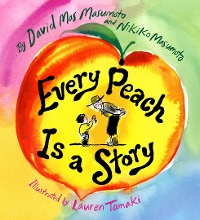 Every Peach Is a Story
by David Mas Masumoto and Nikiko Masumoto; illus. by Lauren Tamaki
Primary Cameron/Abrams 40 pp.
3/25 9781949480290 $18.99
e-book ed. 9798887070735 $17.09
“A peach, like a story, needs time to grow.” Young Midori looks to her grandfather to instruct her about the peaches on their farm. She is impatient for them to ripen, but Jiichan tells her that “we have to wait.” When green, peaches crunch unpleasantly; later, they are yellow but still feel too firm; finally, at summer’s height, they are a deep golden color and smell sweet and “like the rich soil.” Jiichan weaves a story about their family into his teachings, equating green peaches with their Japanese ancestors when they arrived in America (“Things weren’t ready”), then describing how, despite adversity, they put down roots and thrived. Summer passes; Jiichan grows frail and, in winter, dies. Midori visits the cemetery, telling Jiichan that she understands now: “This peach is your story. This peach is our story.” Tamaki’s impressionistic mixed-media illustrations employ a palette that follows the seasons; the art evokes both setting and the close relationship between Midori and Jiichan exquisitely. Notable illustrations include one, in lush golds and greens, of the whole family working the peach harvest; another of bare trees, starkly black against a pale-blue sky, when they “say goodbye to Jiichan.” Coauthor Nikiko Masumoto’s endnote tells more about her family’s California farm, which the book is based on, and discusses in detail experiences alluded to in the story, including racial hostility faced by her immigrant forebears and the WWII incarceration of Japanese Americans. MARTHA V. PARRAVANO
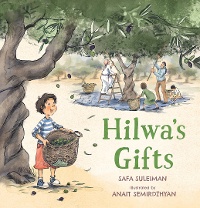 Hilwa’s Gifts
by Safa Suleiman; illus. by Anait Semirdzhyan
Primary Candlewick 40 pp.
4/25 9781536229424 $18.99
Ali visits his grandparents in Palestine, where they grow olive trees on their land. Ali and his seedo (grandfather) have a close bond; Seedo twirls Ali in the air and gives piggyback rides. It’s olive harvesting season, and they visit one particular tree named Hilwa (“sweet one”) that Seedo planted with his grandfather. Ali’s sitty (grandmother) whacks the branches of trees with a stick to harvest the olives, a method that has been passed down through generations. Olive-gathering is a festive affair: Ali’s cousins collect them in baskets while singing “zaytoon, ya zaytoon” (“olives, oh olives”) and dancing. When Ali and Seedo go to the olive press, Seedo explains that olives are one of Hilwa’s many gifts. Hilwa’s last gift is a cutting that Ali plants upon returning home, while Seedo and Sitty watch via video call. Digitally rendered illustrations authentically represent an idyllic Palestinian home and landscape, but the trees and loving extended family remain the focal points. A gentle story about intergenerational bonds and the significance of olive trees to Palestinians as both sustenance and a metaphor representing closeness to the land. An author’s note explains the basis for the story in a childhood memory; a glossary of Arabic words is also appended. JULIE HAKIM AZZAM
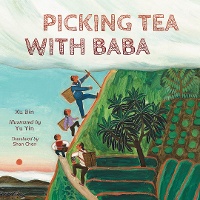 Picking Tea with Baba
by Xu Bin; illus. by Yu Yin; trans. from Chinese by Shan Chen
Primary Charlesbridge 48 pp.
5/25 9781623546236 $18.99
e-book ed. 9781632892683 $9.99
Two siblings join their parents on a rare trip to their baba’s tea garden high in the mountains. Waking before dawn, they hike through thick morning fog, “strapping wicker baskets to [their] backs” and climbing steep paths until they reach the misty fields. There they spend the day picking tea leaves row by row, their hands growing sticky and sore. They chase after bamboo partridges, catch a praying mantis, and drink tea brewed with cool spring water. The day is full of small wonders, from dragonflies circling the garden to a sudden rainstorm that soaks the fields and passes just as quickly. As the sun sets, they sort and bag the leaves, then carefully descend the slippery trail home, delivering their harvest to the tea factory on the way. When their father spots trucks leaving the factory, he proudly calls out, “There go our tea leaves!” Yu’s earthy palette — rich with dark browns, olive greens, and sunlit yellows — roots the story in the landscape. Xu’s text honors the rhythm of nature and tradition and conveys the deep sense of joy that comes from hard work and family unity. Inspired by his own childhood tea-picking days, Xu captures the world through a child’s eyes with warmth and clarity, making this a quietly compelling read. WEILEEN WANG
From the January 2026 issue of Notes from the Horn Book.


Added To Cart
RELATED


RECOMMENDED

Please register with us to continue reading.
ALREADY A SUBSCRIBER? LOG IN
We are currently offering this content for free. Sign up now to activate your personal profile, where you can save articles for future viewing.
ALREADY A SUBSCRIBER? LOG IN
Thank you for visiting.
We’ve noticed you are using a private browser. To continue, please log in or create an account.

Add Comment :-
Be the first reader to comment.
Comment Policy:
Comment should not be empty !!!