


2018 School Spending Survey Report

The Horn Book website has lots of material of interest to teachers. Here are some areas to explore. And follow us on Twitter: #lollysclass
|
Interviews with authors and illustrators Recommended books -- reviews and themed book lists |
School -- reading in school, author visits, and more Suggestion box: what else to you want to see in Lolly's Classroom? |
The Stories Julian Tells
The Stories Julian Tells is the first book in an ongoing series about brothers Julian and Hughie, and their neighbor Gloria.
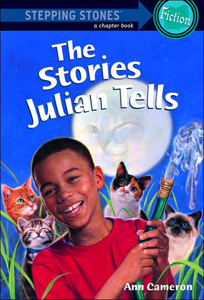 The Stories Julian Tells is the first book in an ongoing series about brothers Julian and Hughie, and their neighbor Gloria. This is an early chapter book, for readers who have acquired some fluency but aren't ready to tackle longer books yet. The chapters are fairly short, there's lots of conversation, the plot is easy to follow, and there is a clear central character.
What do you think of Ann Cameron's writing? Is the story engaging enough for children who are still struggling a bit with reading? And how do you feel about a white author writing a book in which all the characters are African American?


Added To Cart
RELATED


RECOMMENDED
Please register with us to continue reading.
ALREADY A SUBSCRIBER? LOG IN
We are currently offering this content for free. Sign up now to activate your personal profile, where you can save articles for future viewing.
ALREADY A SUBSCRIBER? LOG IN
Thank you for visiting.
We’ve noticed you are using a private browser. To continue, please log in or create an account.

Add Comment :-
Comment Policy:
Comment should not be empty !!!
Jennifer Stacy
I really enjoyed reading about Julian and his family. As I was reading, I tried to think about a conversation I might have with my own child as he were reading the book. I had a similar reaction as a previous commenter to the use of the words "whipping" and "beating." On one hand, I thought it was clever....and yet it also made me a little uncomfortable. One of the things I enjoyed most was Julian's imagination. I loved reading about how he connected the fig leaves to hos own growth and the story of the catalog cats.Posted : Mar 13, 2014 01:47
Felicity Fu
I really appreciated the design of the cover of the book, as I can imagine the age group of readers who are reading the book. The combination of a real life picture of hero with imaginary fictional characters would satisfy the urge of young kids to imagine, especially the content of adventures. The combination of pudding as real food causing trouble sounds like an adventure experienced at home but with a twist of excitement for the readers.Posted : Mar 12, 2014 09:00
Norah Rivera
Julian is a mischief-maker and I love him for it! He really is a fun character and someone many kids can probably relate to. I agree with the comments previously made. I think that this is a great book for young readers. The story is engaging, fun, and with plenty of dialogue, which also makes it a great book to read aloud. I also think that the presence of extensive dialogue is inviting and prevents the reader from being intimidated by long paragraphs. Finally, I think that the illustrations are also very helpful. For a reader who is m,oving from picture books to chapter books, the presence of some illustrations might make the transition easier.Posted : Mar 12, 2014 08:18
Zohra Manjee
I really enjoyed reading this chapter book and found the stories to be engaging and humorous. Particularly, like Mark mentioned, I appreciated the vivid language as I think this is really important to draw young readers into to visualizing the story in their minds as they are transitioning from picture books to easy readers with less images on the page. This vivid language helps to bring the dynamic emotions and relationships to life. Relatedly, I liked the explicit use of dreaming as a way of exploring one's imagination and this space within one's dream was used to identify an alternate ending or wishful thinking, in the case of the fig tree and catalog cats.Posted : Mar 12, 2014 06:04
AnneMarie M.
I am half black and half white, and since I have grown up with both a "white" culture and a "black" culture, I usually find myself able to see issues related to race and its portrayal from two different angles. That's how I feel about The Stories Julian Tells. Like Stacey-Ann, I have no objection to a white author writing about a black family - provided that the author does it well and respectfully, which obviously is a tall order. It can be an incredibly powerful experience to represent other cultures through literature, and it is incredibly important for young children of color to see themselves represented in literature, as my colleagues suggest. As a kindergarten and first grade teacher of classrooms entirely composed of African-American children, I saw this book flying off the lending library shelves constantly. Now that I have read it, there are things that I like and things that I think are rather inappropriate. Like Ashley, I find it disturbing that the dad screams at the boys and that his face looks angry and scary in the illustration, and that the boys say "I'm scared." I do not like that the dad grabs the boys' legs. While my sensitivity to issues about race might be particularly activated in this scene (i.e. someone not of a race portraying people of a different race unfavorably), I would not like this scene even if it depicted a white father doing that to his white sons. That is important for me to reflect upon. How the dad reacts - by making the boys make new pudding - is positive, but I do not particularly appreciate the pun on words about the "beating" and "whipping." I also do not necessarily like the dad's suggestion to use pliers on his son's teeth (I know this is a joke but I don't imagine that joke being entirely clear to all young readers and it is unclear if the dad actually and his teeth pulled out with pliers when he was a child - something that might make children be judgmental). While I think it is completely okay to show negative emotions and events in books, I think that those emotions and events need to be juxtaposed with more positive portrayals, especially when matters of cultural difference come into play. Only alongside other books that portray African-Americans in different (and more positive) ways, would I use this book for children of all races and ethnicities. However, it is a little disturbing to think that some children might have this book be one of the only books that features kids who look like them - or kids who don't. NOTE: I do want to note that most of the other chapters, particularly the "Catalogue Cats" one are much more favorable to me.Posted : Mar 12, 2014 05:17