


2018 School Spending Survey Report

The Horn Book website has lots of material of interest to teachers. Here are some areas to explore. And follow us on Twitter: #lollysclass
|
Interviews with authors and illustrators Recommended books -- reviews and themed book lists |
School -- reading in school, author visits, and more Suggestion box: what else to you want to see in Lolly's Classroom? |
The Stories Julian Tells | Class #3, 2015
The Stories Julian Tells is the first book in an ongoing series about brothers Julian and Hughie, and their neighbor Gloria.
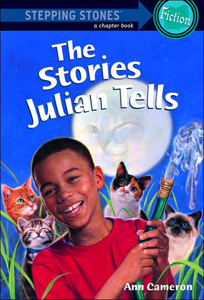 The Stories Julian Tells is the first book in an ongoing series about brothers Julian and Hughie, and their neighbor Gloria. This is an early chapter book for readers who have acquired some fluency but aren’t ready to tackle longer books yet. The chapters are fairly short, there’s lots of conversation, the plot is easy to follow, and there is a clear central character.
What do you think of Ann Cameron’s writing? Is the story engaging enough for children who are still struggling a bit with reading?
How do you feel about a white author writing a book in which all the characters are African American?


Added To Cart
RELATED


RECOMMENDED
Please register with us to continue reading.
ALREADY A SUBSCRIBER? LOG IN
We are currently offering this content for free. Sign up now to activate your personal profile, where you can save articles for future viewing.
ALREADY A SUBSCRIBER? LOG IN
Thank you for visiting.
We’ve noticed you are using a private browser. To continue, please log in or create an account.

Add Comment :-
Comment Policy:
Comment should not be empty !!!
Rebecca Tan
This book manages to touch on themes in a light manner that may otherwise be too heavy or disengaging to manage in easy reader for young children. For example, I appreciated the way in which Julian's mischievous lies and his father's discovery of his lies were managed. Many children let their imagination run wild when they encounter new words and ideas. Julian's imagination is one of the most creative I've encountered. Although Julian is aware he has told his brother fibs, his father skilfully manages the brother's expectations while keeping up the playful attitude. In this way the writer keeps up the creativity and imaginative aspects of the book, the twist engaging readers more and more. In another example, Julian's father's punishment for the two boys after they eat his pudding shows how actions have consequences, but appropriately so. I believe these stories are highly effective in appealing to children's experiences, engaging young readers, and at the same time showing them that mischievousness can have consequences!Posted : Mar 24, 2015 09:35
Mary Winters
I agree with all of the above comments my classmates articulated regarding the figurative language and the ability to use this book as a teaching tool for multiple topics/themes. This book appears to be for readers just delving into chapter books- the thing I liked about it was how each chapter could stand on its own as its own short story, but each chapter could also be read in succession as there are sometimes hints of plot lines from previous chapters. I feel by chunking the book in this way, it makes the book much more manageable for a first-time chapter book reader. It may take some time to get through the whole book, so starting each chapter with a new story does not require the reader to recall events and details throughout the book while reading. I feel this is a great chapter book for children transitioning from picture books to chapter books.Posted : Mar 12, 2015 08:15
Moses Kim
Julian's language in this book is so simple but poetic: like many readers, I could taste the pudding as I read the first chapter! I also appreciated the whimsy of the illustrations, which are grounded in an almost photo-realistic style but incorporate some of the recurring images in the book (like the catalog cats). One thing that I question is the wordplay with "beating" and "whipping." The book *was* written in 1981, when people's views on corporal punishment were very different from what they are now (thanks to research done on its effects), but I imagine that there are still children who may be closeted victims of domestic violence. (I myself was often beat as a child by parents who were well-meaning but hot-tempered.) That Ann Cameron is a white woman writing about African-American families, who are often stereotyped as using physical violence more than other families, is another point I'd be interested in continuing discussion on. That said, it is a very cute pun, and I imagine it being used in the classroom to introduce the concept of wordplay!Posted : Mar 11, 2015 08:32
Allison Bates
Like many of my classmates, I was struck by this chapter book's use of language. It is perfect for young readers who are learning complex words like "catalog," as Huey himself is still learning the word and thus is easy to identify with. Julian's complex descriptions of imaginary events are captivating and entertaining for adults and children alike.Posted : Mar 11, 2015 07:08
Haneen Sakakini
As I began reading this book, as many of my classmates mentioned, I never really thought about who the author was. I was more focused on the story itself. When I teach books in my classroom I tend to only say who the author is, rather than provide a background on the author him/herself. After reading some of the comments above, I valued what Ying said. Knowing that the author is not African American and wrote a book about an African American, can lead to a class discussion as Ying mentioned. It was very refreshing to find a book that I could connect with, even as a 24 year old. Julian reminded me of my older brother. He was able to convince me about just about anything and everything. My brother never convinced me that I could grow taller, but I thought this book was a great read for a younger siblings. Ann does a great job bringing Julian's story to life while keeping young readers engaged throughout the book. As a kid chapter books were pretty daunting, the author's word choice is essential. The words can either be encouraging or discouraging for the reader to continue, personally I felt that this would was very encouraging. The words in this book seemed to be relatable to young readers and exciting and descriptive to keep readers engaged.Posted : Mar 11, 2015 06:47