


2018 School Spending Survey Report

The Horn Book website has lots of material of interest to teachers. Here are some areas to explore. And follow us on Twitter: #lollysclass
|
Interviews with authors and illustrators Recommended books -- reviews and themed book lists |
School -- reading in school, author visits, and more Suggestion box: what else to you want to see in Lolly's Classroom? |
Three graphic novels
Boxers and Saints by Gene Luen Yang (First Second, 2013)
Yummy: The Last Days of a Southside Shorty by G.
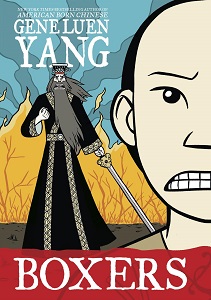


Boxers and Saints by Gene Luen Yang (First Second, 2013)
Yummy: The Last Days of a Southside Shorty by G. Neri, illustrated by Randy DuBurke (Lee & Low, 2010)
Graphic novels are enjoying a surge of interest and critical attention. Gene Luen Yang’s American Born Chinese was the first graphic novel nominated for a National Book Award and was the winner of the 2007 Printz Award. In the two volumes Boxers and Saints, Yang depicts the Boxer Rebellion in China from two very different perspectives. Yummy: The Last Days of a Southside Shorty, written by G. Neri and illustrated by Randy DuBurke, is a fictionalized account of a very young gang member on the run for murder. Graphic novels have been welcomed into high school classrooms (notably Gareth Hinds’s masterful retellings of literary classics, such as Romeo and Juliet and Beowulf), and many teens already devour comics (as Yang calls all such works).
How might students learn from these texts? Should they be paired with more traditional texts to be meaningful, or can a graphic novel study stand alone? Common Core Standards require students to be able to “Integrate and evaluate content presented in diverse formats, including visually, quantitatively.”* How important is visual literacy for our students?
* From College and Career Readiness Anchor Standards for Reading #7


Added To Cart
RELATED


RECOMMENDED

Please register with us to continue reading.
ALREADY A SUBSCRIBER? LOG IN
We are currently offering this content for free. Sign up now to activate your personal profile, where you can save articles for future viewing.
ALREADY A SUBSCRIBER? LOG IN
Thank you for visiting.
We’ve noticed you are using a private browser. To continue, please log in or create an account.

Add Comment :-
Comment Policy:
Comment should not be empty !!!
Emily Sapienza
Reading and reflecting on Yummy, I am reminded of our discussion on the first day of class about whether characters in YA literature should model good values and behavior. Yummy is a complex character. A scared kid who loves his teddy bear (that part slayed me) and a kid who acts out so fiercely that he's committing a felony a week. And then murder. I have had students who could related personally to Yummy; who've done their own bad stuff not because they were bad kids, but because they were in really bad situations. I feel like it would be really powerful to read this book with students and then talk about empathy, and sympathy, and relating. But also talk about choices and agency. To this end, I certainly think the work could stand alone as a teaching text for students. While I believe that visual literacy is important, I don't think it's a question so much of teaching it; kids get SO MUCH visual information today. More, I think it's a question of helping students filter and discern the plethora and myriad of images they are flooded with daily. As a verbal, not visual, learner, graphic novels are tough for me. But I appreciated this the book a lot; I think it was artfully crafted and was effective as verbal AND visual story.Posted : Nov 23, 2014 11:18
Catherine Healy
When I was growing up, I thought that all "comics" were about superheroes (except the Archie comics), and that none of them were worth my time. Only in adulthood did I discover Maus, Persepolis, and Dykes to Watch Out For and find out what I had been missing! I absolutely believe that graphic novels can stand alone in the classroom -- in addition to their capacity for greatness based on their own merits, they put readers in a mental space different from that triggered by traditional texts, making them open to learning about otherwise frightening or off-putting topics. An English-teacher friend of mine has had great success in teaching Alison Bechdel's Fun Home to high-school seniors; while students might initially be hesitant about Bechdel's frank discussion of sexuality, or bored by her heavy introspection about herself and her father, the graphic-novel format helps them let down their guard and relax into the story. As our society orients us more and more toward the visual, and advertising becomes more and more sophisticated (topics we addressed in our class discussion of Feed), visual literacy is becoming more important than ever. Because they are so easy to engage with at a variety of levels, graphic novels are a great tool for talking about visual literacy with students who might not think of themselves as interested in art. I read Yummy for this week's assignment. I'm not sure I would use it as the "core text" for a unit, but I could imagine a million ways to use it in the classroom -- especially in talking about how the "Hero's Journey" can break down along the way, and how a hero (if we can consider Yummy a hero ... ?) can come to a not-so-heroic end.Posted : Nov 23, 2014 09:45
Nancy
I'm so glad to have found Boxers by Gene Luen Yang. His book American Born Chinese was the first graphic novel I've read, from a recommendation by a high school librarian. I remember not knowing whether to approach it lightly like for a comic or whether to be in the same mindset as reading a traditional novel. I love Yang's style of art - not too overly detailed or decorated, bold lines, at times minimalist, a style adapted to disappear while carrying along the narrative, rather than a style too self-consciously "illustrated" that it jerks the reader out of the story to inspect artistic merits. I agree that graphic novels serve very well as core texts and are capable of standing alone. As well the many advantages listed by others, graphic novels offer a powerful way of exploring perspective and point of view in story telling.Posted : Nov 23, 2014 09:02
Amy Lipton
Personally, I struggle with visual literacy, and I find it hard to connect with picture books or graphic novels. That being said, I fully appreciate what they have to offer in terms of learning and education. Pook perfectly summarized the value that graphic novels hold for students who are less engaged in reading (for whatever reason that may be). Graphic novels have the power to captivate students in a different way than normal books; I believe the surge of interest in graphic novels as a genre reflects the increasing understanding and appreciation of the various ways in which students learn. Despite the fact that I am usually uninterested in graphic novels, I truly enjoyed reading Yummy. The story was gut-wrenching, and brutally honest. And, while I normally find the illustrations in graphic novels to be distracting, I thought these pictures heightened the emotion of the story in a really effective way.Posted : Nov 23, 2014 08:11
Kara Brennan
I said this is my post about picture books (because I did not read this question before answering that one, oops) but I absolutely think that graphic novels can be great in a classroom. Again, I'm not a teacher, but I would think that they should probably be paired with a traditional text, for those students that struggle to understand how to read graphic novels in the most productive way. I once had a professor that wrote her dissertation on graphic novels, and she gave us a seminar on the technically "correct" way to read them, which involved going through the book once just letting your eyes just take in the illustrations, and then reading it again to take in the text. And different books want you to read in different directions, and many are designed so that you can read in any direction that you choose. I would assume that most high school students do not know about this unique reading style, so a traditional text would probably be useful to supplement the information. But they are clearly great for kids with reading disabilities, because this same professor was also severely dyslexic, and graphic novels changed the whole way that she read. And for kids that have different learning styles I would think that having the option of learning things visually would be a huge advantage, especially with heavy subjects that are addressed in novels like these novels, or American Born Chinese or Maus.Posted : Nov 23, 2014 08:07